Violence and Corruption
Genesis says the wickedness of man was great and that the earth was corrupt and filled with violence. See Genesis 6:5, 11–13.
Genesis Collection • Exhibit 4 of 8
By the days of Noah, Genesis describes a world deeply corrupted by violence and wickedness. Against that background, Noah found grace in the eyes of the LORD. God instructed him to build an ark, preserve his family and bring living creatures aboard before the waters of the Flood came upon the earth.
Featured Museum Artwork
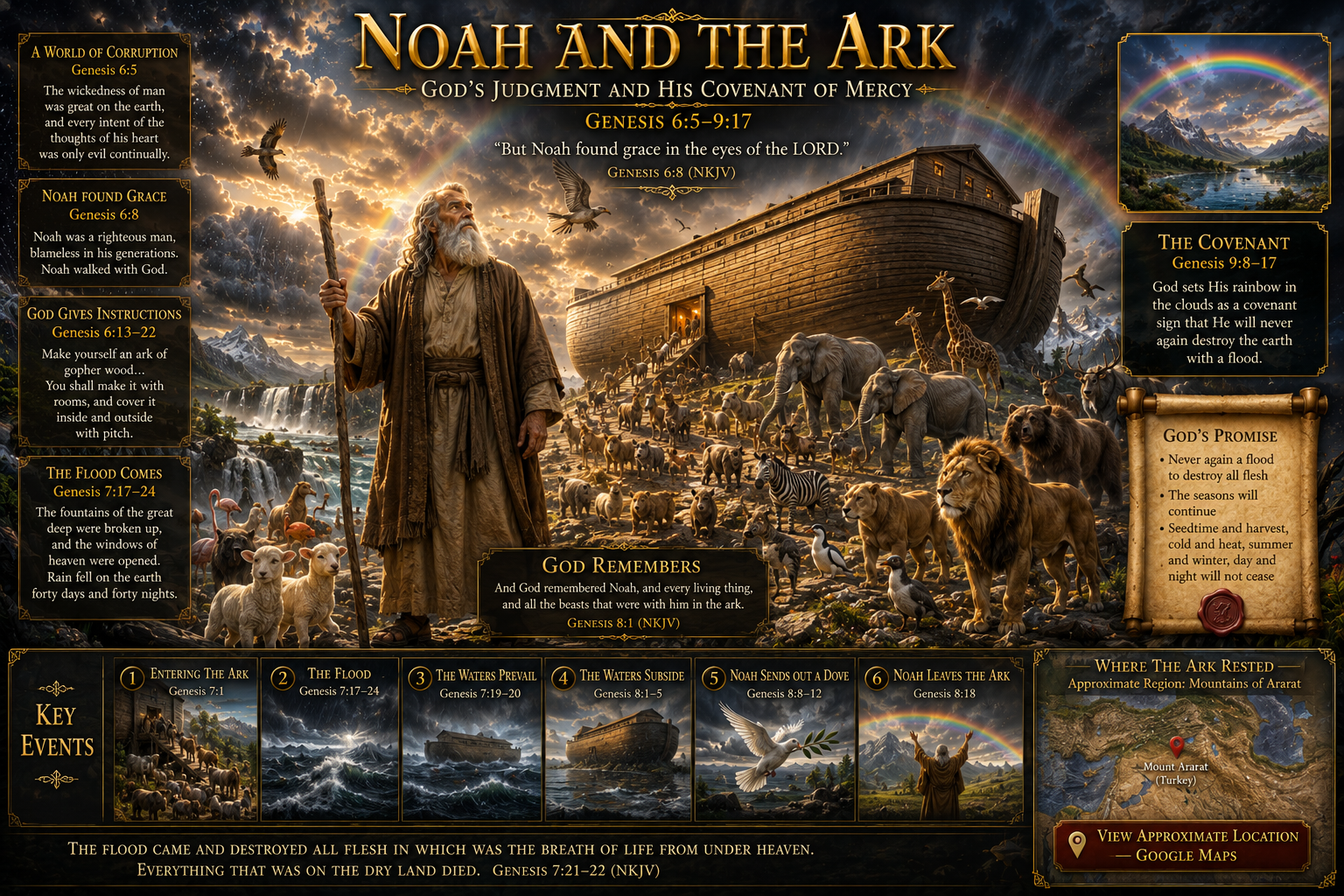
Genesis 6–9 gives far more detail than simply the building of an ark. It records the condition of the world, Noah's character, God's instructions, the preservation of Noah's family and the animals, the Flood itself, the ark's resting place, Noah's worship and God's covenant sign of the rainbow.
Genesis says the wickedness of man was great and that the earth was corrupt and filled with violence. See Genesis 6:5, 11–13.
Noah is described as a just man, perfect in his generations, and Genesis says that Noah walked with God. He had three sons: Shem, Ham and Japheth. See Genesis 6:9–10.
God instructed Noah to make an ark of gopherwood, with rooms, pitch inside and outside, a window, a door and three decks. See Genesis 6:14–16.
Genesis emphasizes Noah's obedience: “Thus Noah did; according to all that God commanded him, so he did.” See Genesis 6:22.
Noah entered the ark with his wife, his sons and his sons' wives. Animals and birds also entered according to God's instructions. See Genesis 7:1–9.
Rain fell upon the earth for forty days and forty nights, and the waters increased greatly. See Genesis 7:12, 17–24.
Genesis 8 opens with the statement that God remembered Noah and every living thing with him in the ark. A wind passed over the earth and the waters began to subside. See Genesis 8:1–3.
The ark rested upon the mountains of Ararat on the seventeenth day of the seventh month. Scripture refers to the mountains of Ararat rather than identifying a specific modern summit. See Genesis 8:4.
Genesis gives the dimensions in cubits. Because the exact length of the ancient cubit used in this account is debated, the biblical measurements are best presented first rather than claiming one exact modern conversion.
Noah sent out a raven and later a dove to determine whether the waters had receded. The dove eventually returned with a freshly plucked olive leaf. See Genesis 8:6–12.
After leaving the ark, Noah built an altar to the LORD and offered burnt offerings. Noah's first recorded action after leaving the ark was an act of worship. See Genesis 8:18–22.
God blessed Noah and his sons and told them to be fruitful, multiply and fill the earth. See Genesis 9:1.
God established His covenant with Noah, his descendants and living creatures, promising that the waters would never again become a flood to destroy all flesh. The rainbow was given as the sign of the covenant. See Genesis 9:8–17.
The account of Noah brings together judgment, grace, obedience, preservation, worship and covenant. Genesis contrasts a violent and corrupt world with a man who walked with God and obeyed His instructions. After judgment came preservation, and after the Flood God established a covenant whose sign was placed in the clouds.
Continue the Genesis Collection
The Genesis story now moves toward the patriarchs and God's call to Abram: a journey from his homeland toward the land God would show him, together with extraordinary promises concerning his descendants and the nations.