Cain Was Born First
Cain was the first son named in Genesis 4. Eve's words at his birth are recorded in Genesis 4:1. Abel was born afterward as Cain's younger brother.
Genesis Collection • Exhibit 3 of 8
Genesis 4 introduces the first children born to Adam and Eve. Cain was born first, followed by his brother Abel. Their story moves from work and worship to warning, jealousy, murder, judgment and exile, while Genesis also records the beginning of Cain's family line and several developments among his descendants.
Featured Museum Artwork
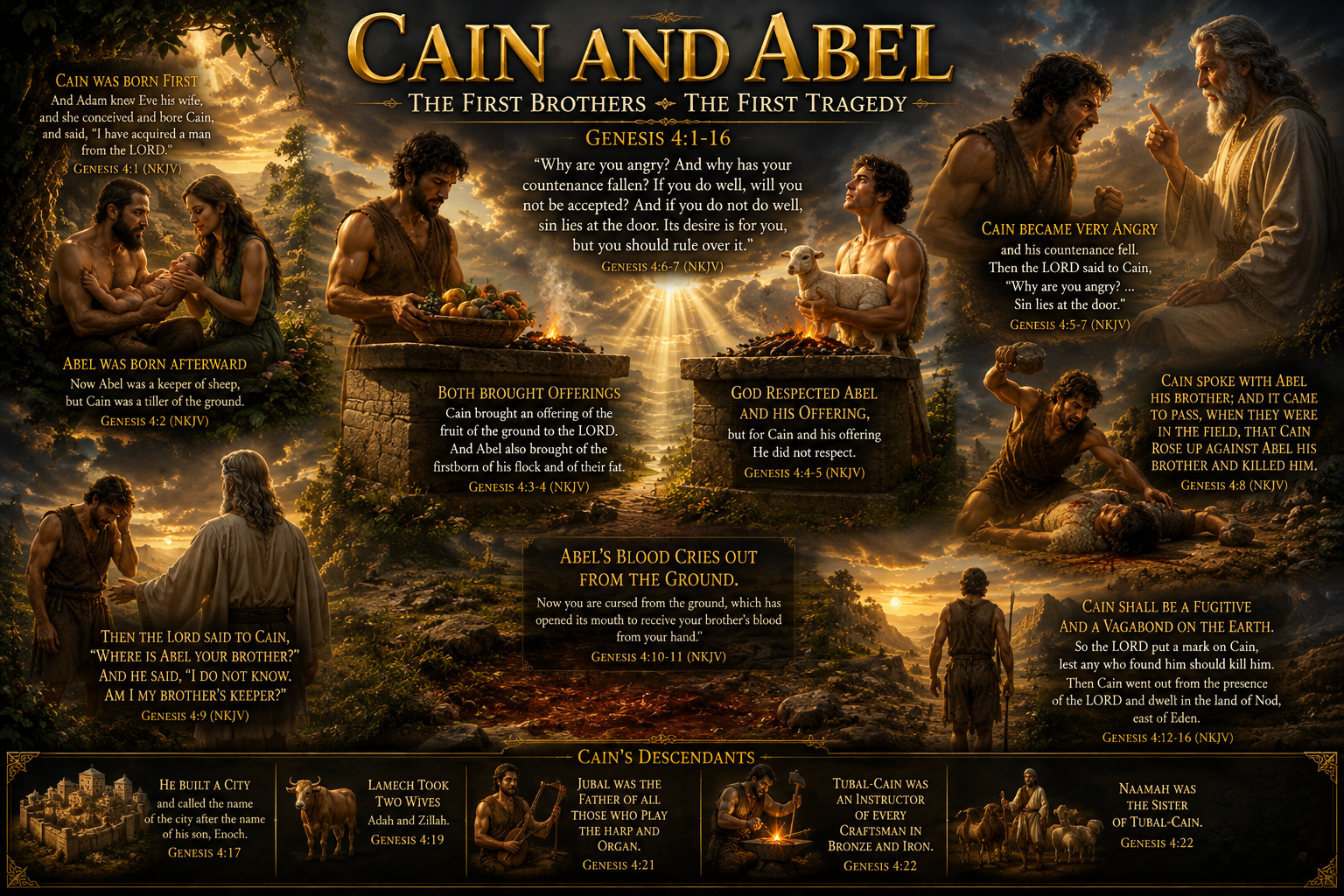
Genesis gives us a compact but deeply significant account. Cain and Abel were brothers with different occupations, both brought offerings to the LORD, Cain was warned about the danger growing within him, and the chapter records the first murder in Scripture.
Cain was the first son named in Genesis 4. Eve's words at his birth are recorded in Genesis 4:1. Abel was born afterward as Cain's younger brother.
Abel became a keeper of sheep, while Cain became a tiller of the ground. Their daily work forms the background to the offerings they later brought. See Genesis 4:2.
Cain brought an offering of the fruit of the ground. Abel brought of the firstborn of his flock and of their fat. Genesis specifically records that the LORD respected Abel and his offering. See Genesis 4:3–5.
When Cain and his offering were not regarded in the same way, Cain became very angry and his countenance fell. God confronted him directly about what was happening within him. See Genesis 4:5–6.
Before the murder, God warned Cain that sin was lying at the door, that its desire was for him, and that he should rule over it. This warning comes before Cain acts against Abel. See Genesis 4:6–7.
Cain spoke with Abel, and while they were in the field Cain rose up against his brother and killed him. Genesis records the first human death at the hands of another person. See Genesis 4:8.
The LORD asked Cain where Abel was. Cain answered that he did not know and asked, “Am I my brother's keeper?” See Genesis 4:9.
God declared that Abel's blood cried out from the ground. Cain was cursed in relation to the ground and would become a fugitive and a vagabond on the earth. See Genesis 4:10–12.
One of the most important details in the account is that Cain was not left without warning. God addressed his anger before the violence occurred. The text places personal responsibility directly before Cain.
Cain feared that someone who found him would kill him. The LORD set a mark on Cain so that anyone finding him would not kill him. Genesis does not describe the physical appearance of this mark. See Genesis 4:13–15.
Cain went out from the presence of the LORD and dwelt in the land of Nod, east of Eden. Its precise modern location cannot be identified with certainty. See Genesis 4:16.
Cain knew his wife, she bore Enoch, and Cain built a city which he named after his son Enoch. See Genesis 4:17.
Jabal is described as the father of those who dwell in tents and have livestock. See Genesis 4:20.
Jubal is described as the father of all those who play the harp and flute. Genesis therefore connects Cain's family line with early musical development. See Genesis 4:21.
Tubal-Cain was an instructor of craftsmen in bronze and iron, and Genesis also names his sister Naamah. See Genesis 4:22.
Genesis 4 reveals how quickly sin moves from the heart into human relationships. The chapter begins with birth, family, work and worship, but jealousy grows into anger and then into bloodshed. At the same time, God's warning to Cain shows that Cain was confronted before he acted, and the later genealogy demonstrates that human culture and skill continued to develop even within a broken world.
Continue the Genesis Collection
Genesis next moves from the first family to a world increasingly marked by corruption, and to Noah, a man who found grace in the eyes of the LORD.