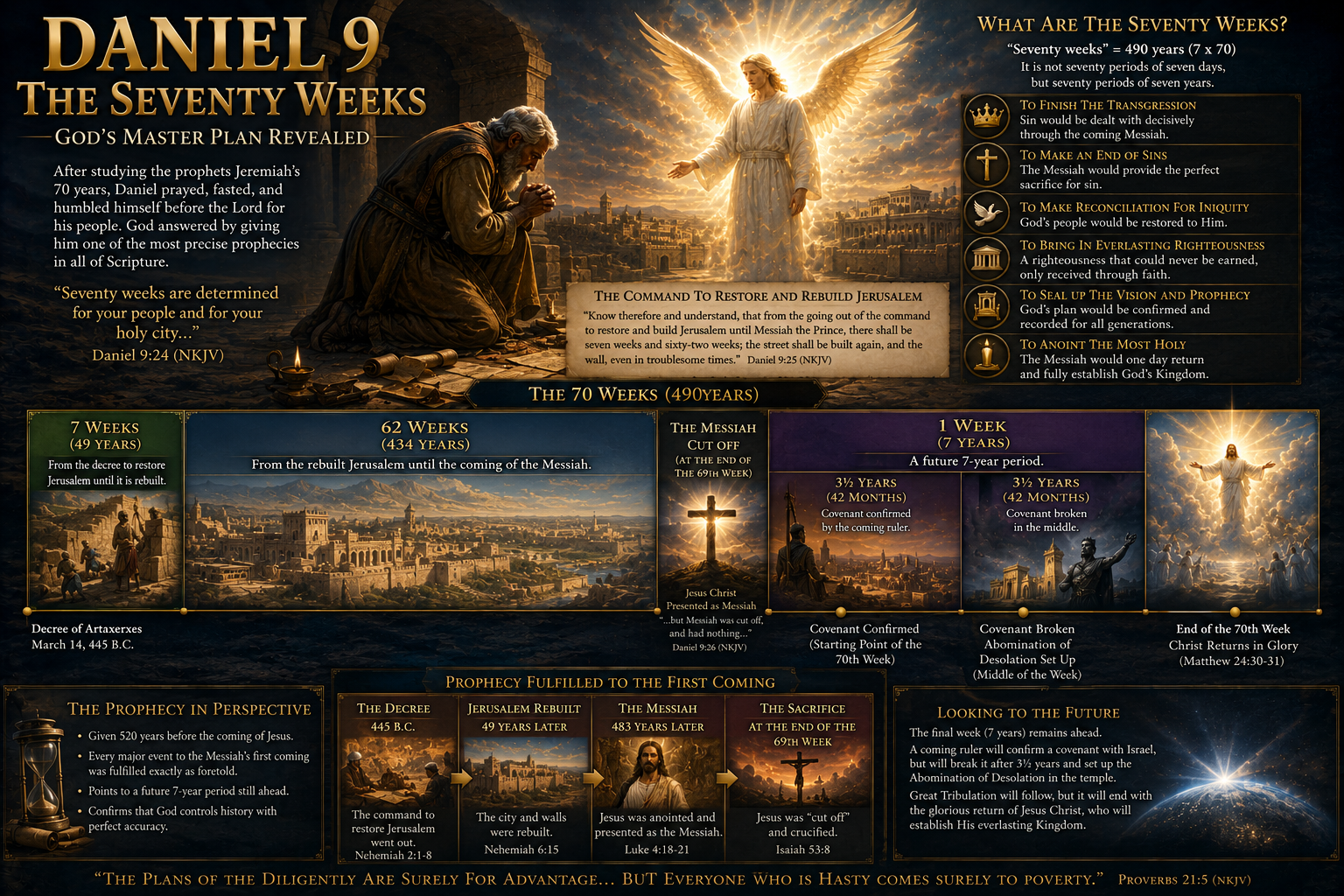
Daniel 9 — The Seventy Weeks
God's Master Plan Revealed
Daniel 9:1–27 (NKJV)
Introduction to the Master Plan
In Daniel 9, we encounter one of the most breathtaking and mathematically precise prophecies in all of sacred history. After studying the prophecies of Jeremiah concerning the 70 years of captivity, Daniel humbled himself in deep prayer, fasting, and repentance on behalf of his people.
In immediate response, God sent the angel Gabriel to give Daniel a sweeping roadmap of future history—spanning 490 years (seventy weeks of years)—culminating in the advent of the Messiah, His substitutionary sacrifice, and the ultimate establishment of God's eternal kingdom.
STEP 1
Daniel Seeks the Lord
When Heaven Answered a Praying Man (Daniel 9:1–3)
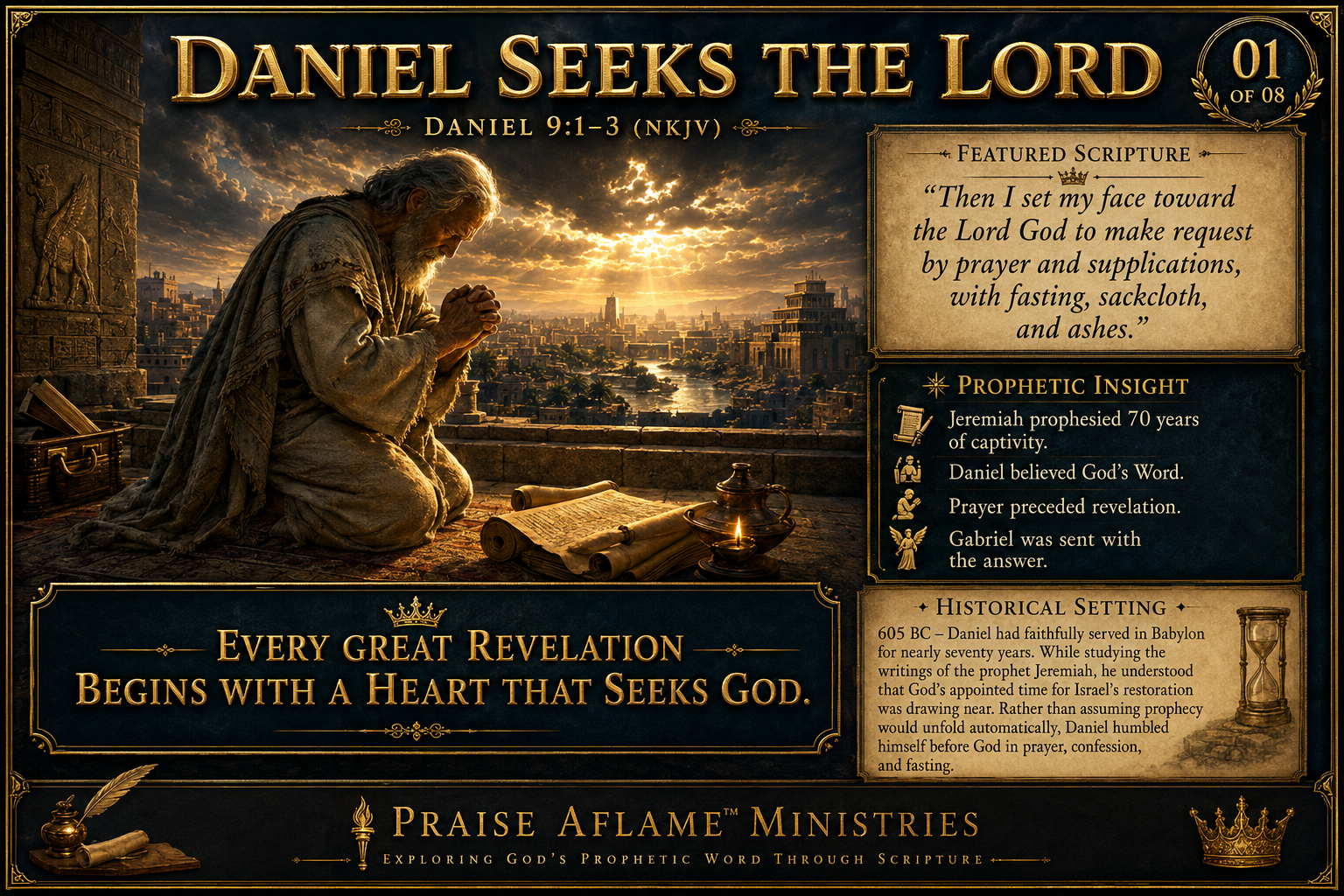
There are moments in Scripture when history seems to pause and heaven draws near. Daniel chapter nine records one of those extraordinary moments. Before an angel appeared, before one of the greatest prophecies in the Bible was revealed, and before the timeline of the coming Messiah was unveiled, there was simply an elderly man kneeling in prayer.
Daniel was no longer the young captive who had been taken from Jerusalem decades earlier. Nearly seventy years had passed since Nebuchadnezzar carried the people of Judah into Babylon. Kingdoms had risen and fallen. Kings who once ruled the ancient world had disappeared into history. Yet Daniel remained faithful.
He had lived through the reigns of Nebuchadnezzar, Belshazzar, Darius, and now Cyrus. While empires changed around him, one thing never changed—his devotion to the God of Israel.
An aging prophet kneels quietly with the scrolls of Scripture opened before him. The noise of Babylon fades into the background while the Word of God commands his full attention. This is not merely a man reading ancient writings. It is a servant of God searching the Scriptures because he believes every promise the Lord has spoken.
Daniel was reading the writings of the prophet Jeremiah. Centuries earlier, Jeremiah had declared that Judah would remain in captivity for seventy years because of the nation's persistent rebellion against God (Jeremiah 25:11–12; Jeremiah 29:10). As he counted the years, he realized the seventy years were almost complete. God's appointed time was approaching.
Yet Daniel did not assume that because God had made a promise, there was nothing left for him to do. Instead, the prophecy drove him to prayer. The promises of God never produce spiritual laziness. They awaken faith, humility, repentance, and dependence upon the Lord.
Notice the description Daniel gives of his own response:
“Then I set my face toward the Lord God to make request by prayer and supplications, with fasting, sackcloth, and ashes.” — Daniel 9:3 (NKJV)
Those words reveal a heart completely surrendered to God. To "set his face" means Daniel approached the Lord with deliberate focus. His fasting demonstrated dependence upon God rather than earthly strength, while sackcloth and ashes symbolized humility and repentance. Although Daniel is consistently portrayed as one of the most righteous men in Scripture, he identified himself with the sins of his nation.
The New Testament echoes this same attitude when James writes, “God resists the proud, but gives grace to the humble.” (James 4:6). It is no coincidence that one of the greatest prophetic revelations in history came immediately after one of the greatest prayers recorded in Scripture.
Daniel chapter nine reminds us that prophecy is never given merely to satisfy human curiosity about the future. God's prophetic Word is intended to draw His people into deeper fellowship with Him. Before Gabriel ever appeared, before the seventy weeks were revealed, and before the Messiah was foretold, there was one elderly servant quietly kneeling before the Lord with an open Bible and a surrendered heart. Everything that follows in Daniel's remarkable prophecy begins here—not with empires, kings, or timelines, but with a man who believed the Word of God enough to pray.
STEP 2
Gabriel Brings the Message
Heaven Responds to a Praying Heart (Daniel 9:20–23)
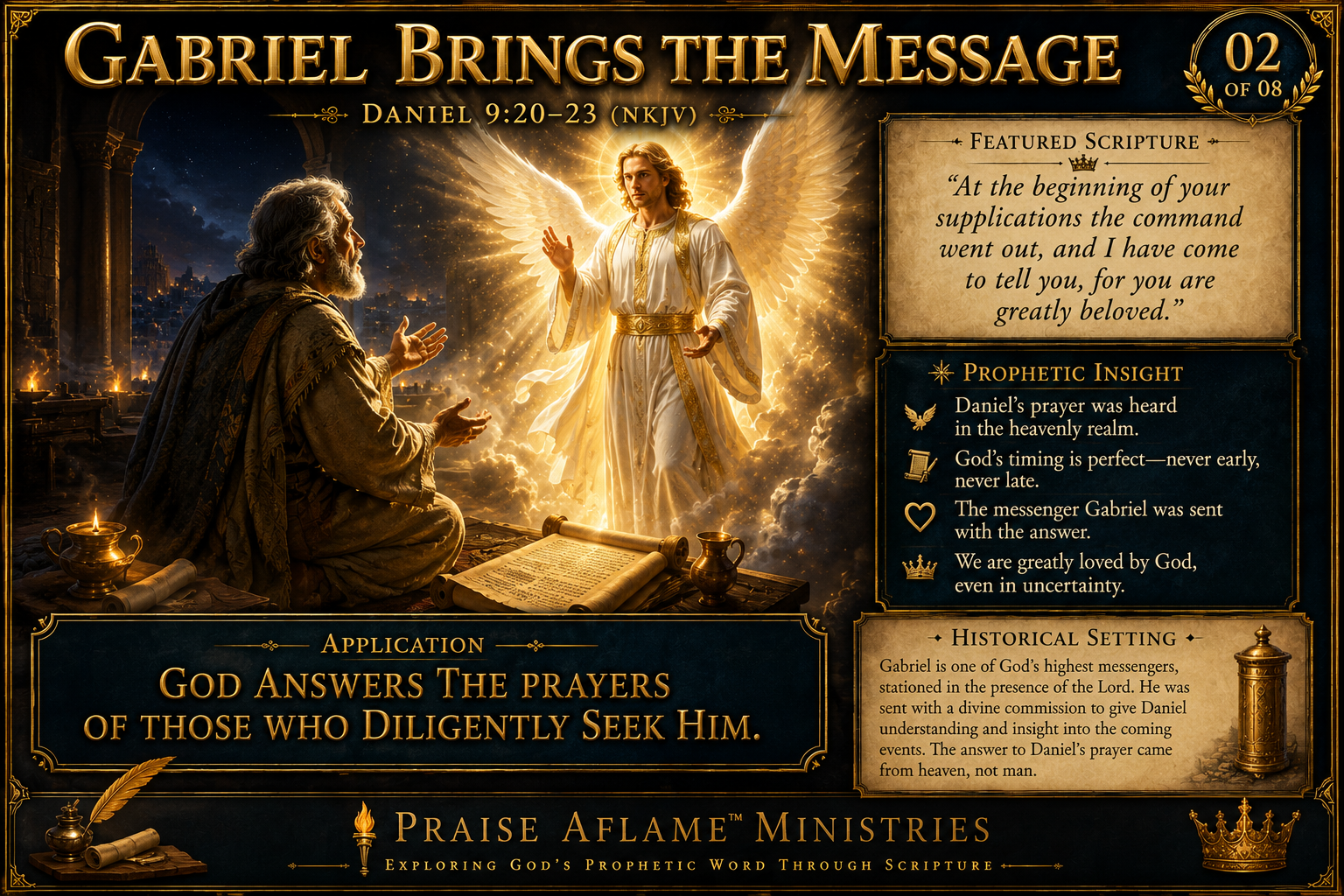
Throughout the pages of Scripture there are moments when the unseen world briefly becomes visible. Daniel chapter nine records one of those extraordinary occasions. While the prophet was still bowed before God in prayer, the Lord answered—not with a feeling or an impression, but by sending one of heaven's highest-ranking messengers.
Daniel has not finished praying. His confession is still rising before the throne of God. The scrolls of Jeremiah remain open before him. Then suddenly the room is flooded with heavenly light. Gabriel stands before the prophet carrying one of the greatest prophetic revelations ever entrusted to humanity.
Daniel tells us: “Now while I was speaking, praying, and confessing my sin and the sin of my people Israel, and presenting my supplication before the LORD my God... yes, while I was speaking in prayer, the man Gabriel... reached me about the time of the evening offering.” (Daniel 9:20–21, NKJV). Daniel was still praying when Gabriel arrived. God did not wait until the prayer ended; the answer was already on its way.
Notice something else that is deeply significant: Daniel mentions the evening sacrifice. At this point in history, the Temple in Jerusalem had been destroyed for decades. No lamb was being offered upon the altar. Yet Daniel continued to order his life according to God's appointed times. His body lived in Babylon, but his heart worshipped in Zion.
When Gabriel speaks, his opening words are filled with grace: “O Daniel, I have now come forth to give you skill to understand.” (Daniel 9:22, NKJV). Prophecy is never discovered by human intelligence alone; it is revealed by divine revelation. Gabriel then adds: “At the beginning of your supplications the command went out, and I have come to tell you, for you are greatly beloved.” (Daniel 9:23, NKJV).
Daniel's prayer had been about Israel's restoration. God's answer revealed something far greater—His complete redemptive timetable. Daniel asked about seventy years, but God answered with seventy weeks. Daniel sought understanding about the restoration of one city, but God revealed the redemption of the entire world, doing exceedingly abundantly above all that we ask or think (Ephesians 3:20).
STEP 3
Jerusalem Shall Be Rebuilt
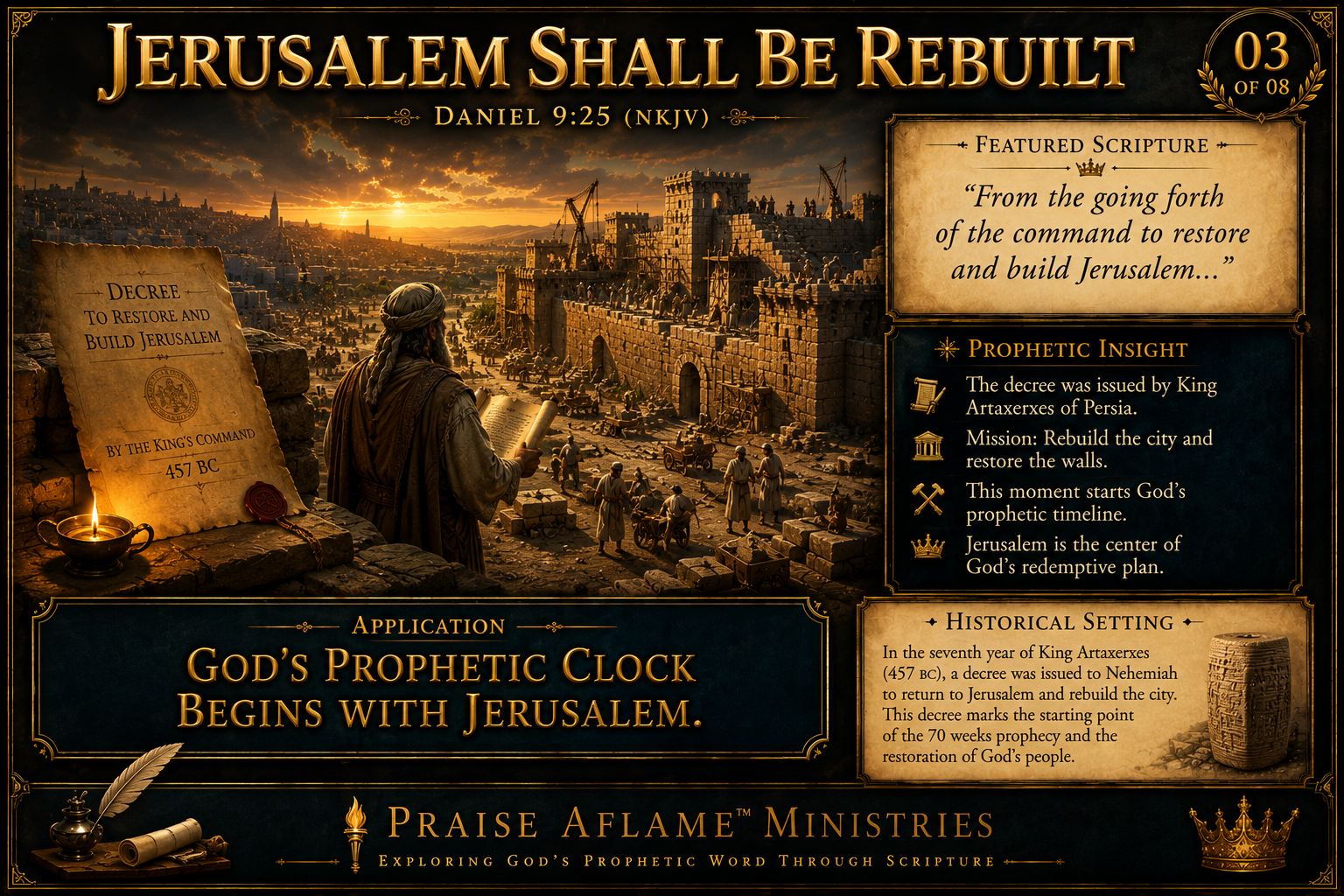
The City That Restarted God's Prophetic Clock (Daniel 9:25)
Few cities in the history of the world have carried the significance of Jerusalem. When Gabriel continued speaking to Daniel, he did not begin with distant kingdoms or mysterious symbols. Instead, he pointed to a very specific historical event—one that could be observed, recorded, and verified.
“Know therefore and understand, that from the going forth of the command to restore and build Jerusalem until Messiah the Prince...” (Daniel 9:25, NKJV). These opening words anchor prophecy to history. God did not reveal an abstract vision detached from the real world; He identified an actual decree to rebuild Jerusalem as the starting point of His prophetic timetable.
When Daniel first received this message, Jerusalem lay in ruins. Its walls had been torn down by the Babylonians and the Temple destroyed. To human eyes the city appeared finished, but God saw restoration. Generations later, God stirred the hearts of Persian kings to allow Jewish exiles to return home. Leaders such as Zerubbabel, Ezra, and Nehemiah became instruments in God's hands. Nehemiah led the rebuilding of Jerusalem's walls while families worked side by side, building with one hand and holding a weapon with the other (Nehemiah 4:17–18).
Gabriel had foretold that “the street shall be built again, and the wall, even in troublesome times.” (Daniel 9:25, NKJV). The rebuilding took place amid political pressure and threats, demonstrating that God's purposes often advance through difficulty rather than around it.
Jerusalem's restoration restarted God's prophetic clock, pointing forward from this decree to the coming of "Messiah the Prince." The restored city would become the setting for the earthly ministry of Jesus Christ. What appeared to be a local construction project was, in reality, preparation for the arrival of the Savior of the world.
STEP 4
The Seventy Weeks Revealed
God's Master Timeline of Redemption (Daniel 9:24–27)
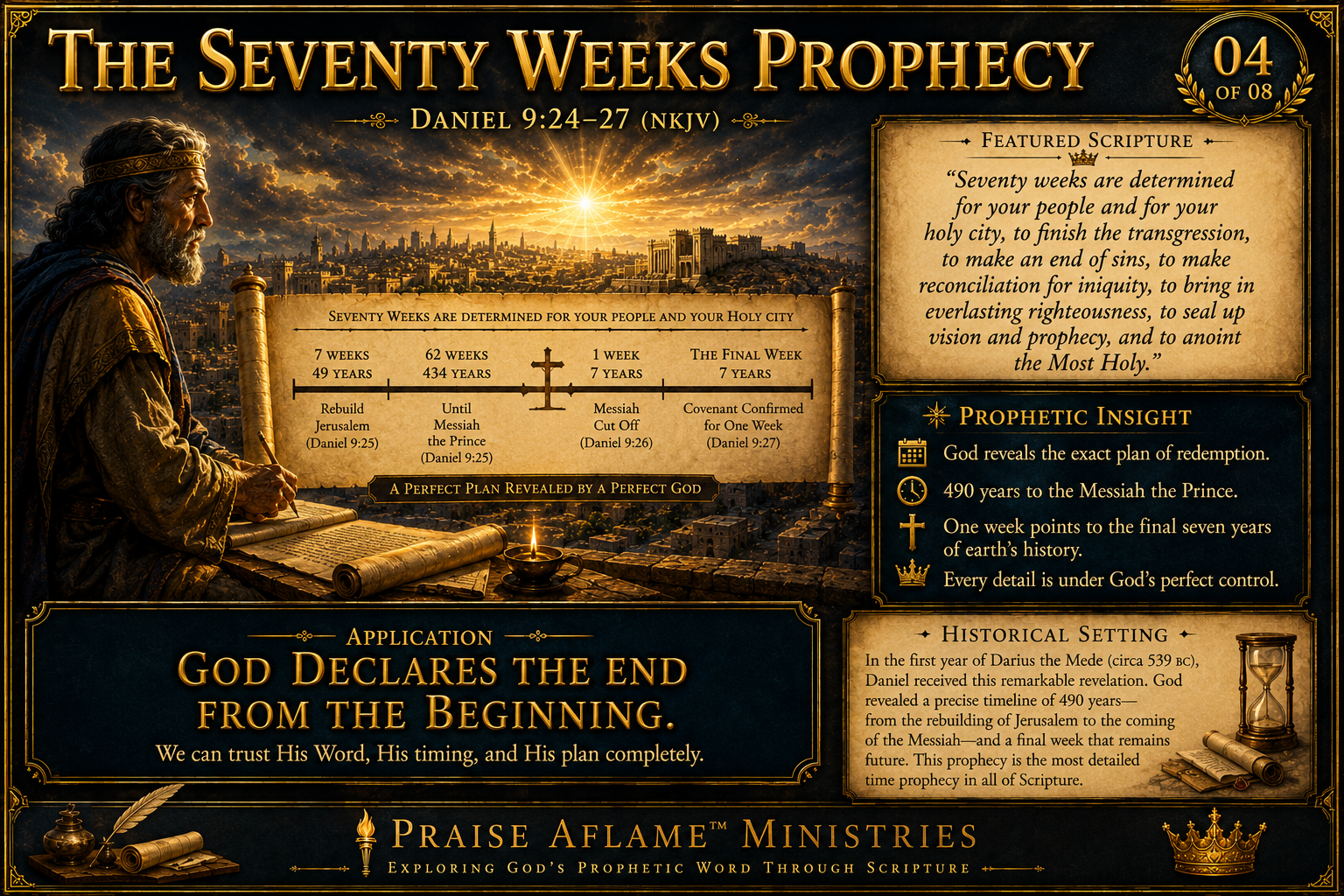
Gabriel unveiled God's redemptive timetable—a prophetic framework stretching from Daniel's day to the coming of the Messiah and beyond. Gabriel began with these remarkable words: “Seventy weeks are determined for your people and for your holy city...” (Daniel 9:24, NKJV). The phrase "seventy weeks" literally means "seventy sevens" representing 490 years.
Gabriel lists six divine purposes that will be accomplished during this prophetic period:
- To Finish the Transgression: Appointing a conclusion to human rebellion according to His redemptive plan.
- To Make an End of Sins: Providing the remedy through the coming Messiah who would bear the sins of many.
- To Make Reconciliation for Iniquity: Pointing directly toward the Cross, where “God was in Christ reconciling the world to Himself.” (2 Corinthians 5:19, NKJV).
- To Bring In Everlasting Righteousness: Reaching beyond temporary political restoration toward Christ's eternal Kingdom.
- To Seal Up Vision and Prophecy: Bringing God's revealed purposes to their complete and intended fulfillment.
- To Anoint the Most Holy: Culminating in God's holy presence dwelling among His redeemed people.
These six purposes reveal that Daniel's prophecy is primarily about redemption. Gabriel then states: “And after the sixty-two weeks Messiah shall be cut off, but not for Himself...” (Daniel 9:26, NKJV). Centuries before Calvary, God revealed that His Messiah would suffer a violent death not for His own sin, but on behalf of others, fulfilling Isaiah 53.
STEP 5
Messiah Shall Be Cut Off
The Cross Was Always God's Plan (Daniel 9:26)
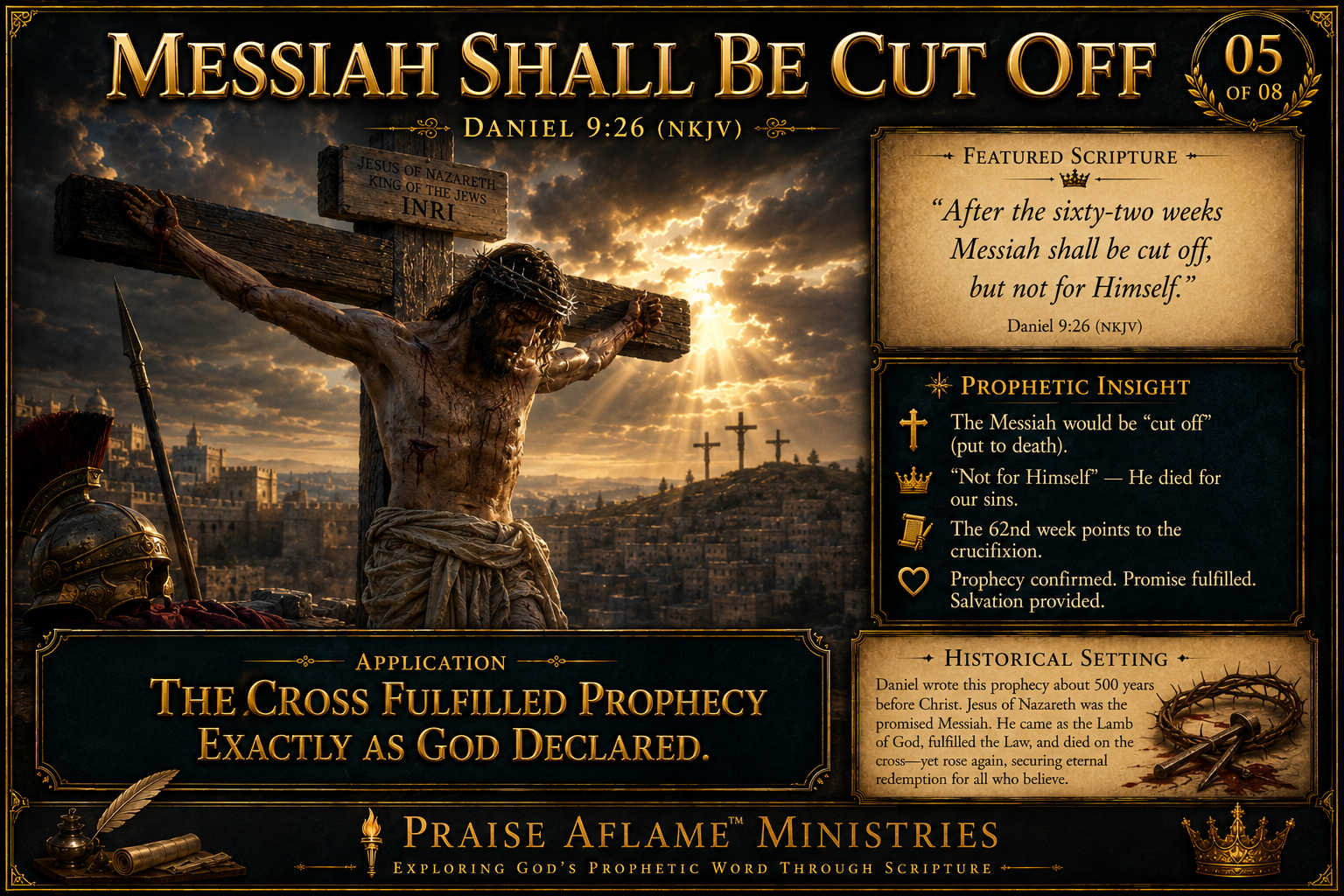
As Gabriel continued unveiling God's prophetic timetable, he spoke words that must have astonished Daniel: “And after the sixty-due weeks Messiah shall be cut off, but not for Himself...” (Daniel 9:26, NKJV). Rather than describing the Messiah ascending a throne or defeating Israel's enemies first, Gabriel declares that He will be "cut off."
This was not the kind of Messiah many expected, but before Jesus could reign as King, He would offer Himself as the sacrifice for sin. The Cross did not surprise heaven; it fulfilled heaven's eternal purpose. Standing outside Jerusalem on that solemn day, crowds witnessed what they thought was the tragic end of Jesus of Nazareth, when in reality they were witnessing the greatest demonstration of God's love.
The words "cut off" speak of a violent death, but Gabriel immediately adds: “...but not for Himself.” Jesus did not die because He had sinned; He died for others. John the Baptist declared, “Behold! The Lamb of God who takes away the sin of the world!” (John 1:29, NKJV). Isaiah had seen this centuries earlier: “He was wounded for our transgressions, He was bruised for our iniquities...” (Isaiah 53:5, NKJV).
The Apostle Paul summarized this mystery: “For He made Him who knew no sin to be sin for us, that we might become the righteousness of God in Him.” (2 Corinthians 5:21, NKJV). At Calvary, God's justice was fully satisfied and His mercy fully displayed, echoing Jesus' cry from the Cross: “It is finished!” (John 19:30, NKJV).
STEP 6
The Final Week
The Final Chapter Before the King's Return (Daniel 9:27)
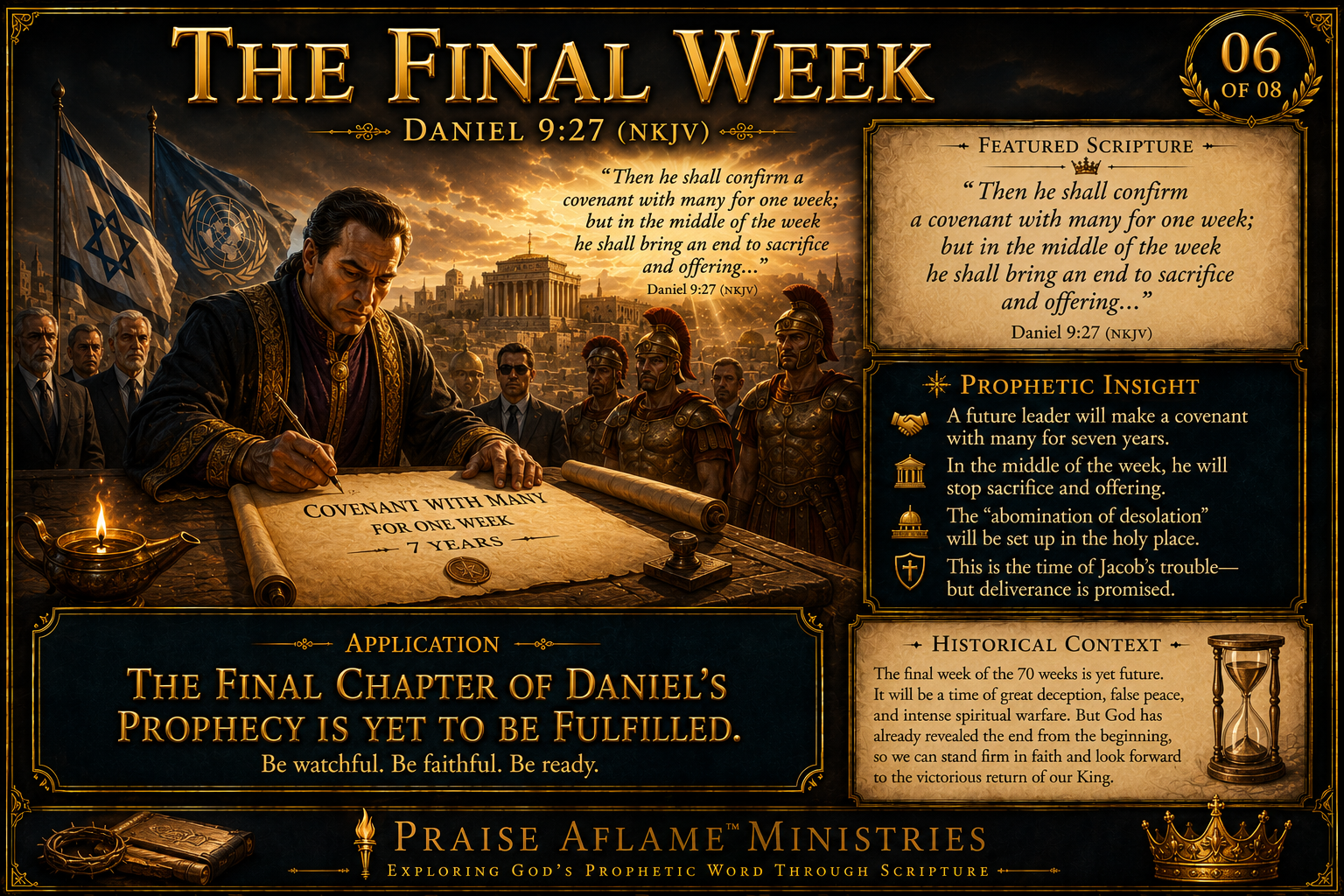
As Gabriel concluded his extraordinary revelation to Daniel, one final period remained in God's prophetic timetable. Daniel records: “Then he shall confirm a covenant with many for one week; but in the middle of the week he shall bring an end to sacrifice and offering. And on the wing of abominations shall be one who makes desolate...” (Daniel 9:27, NKJV).
Many evangelical interpreters understand this final "week" as a future seven-year period unfolding immediately before Christ's return, while others see connections to the first century. Whatever position one adopts, every believer can affirm that God's purposes will be fulfilled exactly as He has declared. Lasting peace cannot be established merely through political agreements; true peace comes only through the reign of the Prince of Peace.
Many students of prophecy believe this covenant marks the beginning of a final period of world history characterized by spiritual deception and global conflict, echoing Jesus' warnings in Matthew 24 and Paul's writing in 2 Thessalonians 2. Furthermore, Jesus directed His disciples back to Daniel when speaking of the "abomination of desolation standing in the holy place" (Matthew 24:15), confirming the unity of Scripture.
One of the greatest lessons of this final week is that evil is never allowed unlimited authority. God establishes the boundaries, determines the duration, and announces the conclusion before history even arrives there, calling believers to faithfulness, watchfulness, and steadfast hope.
STEP 7
The Return of the King
The Day Every Prophecy Finds Its King (Daniel 7:13–14; Revelation 19:11–16)
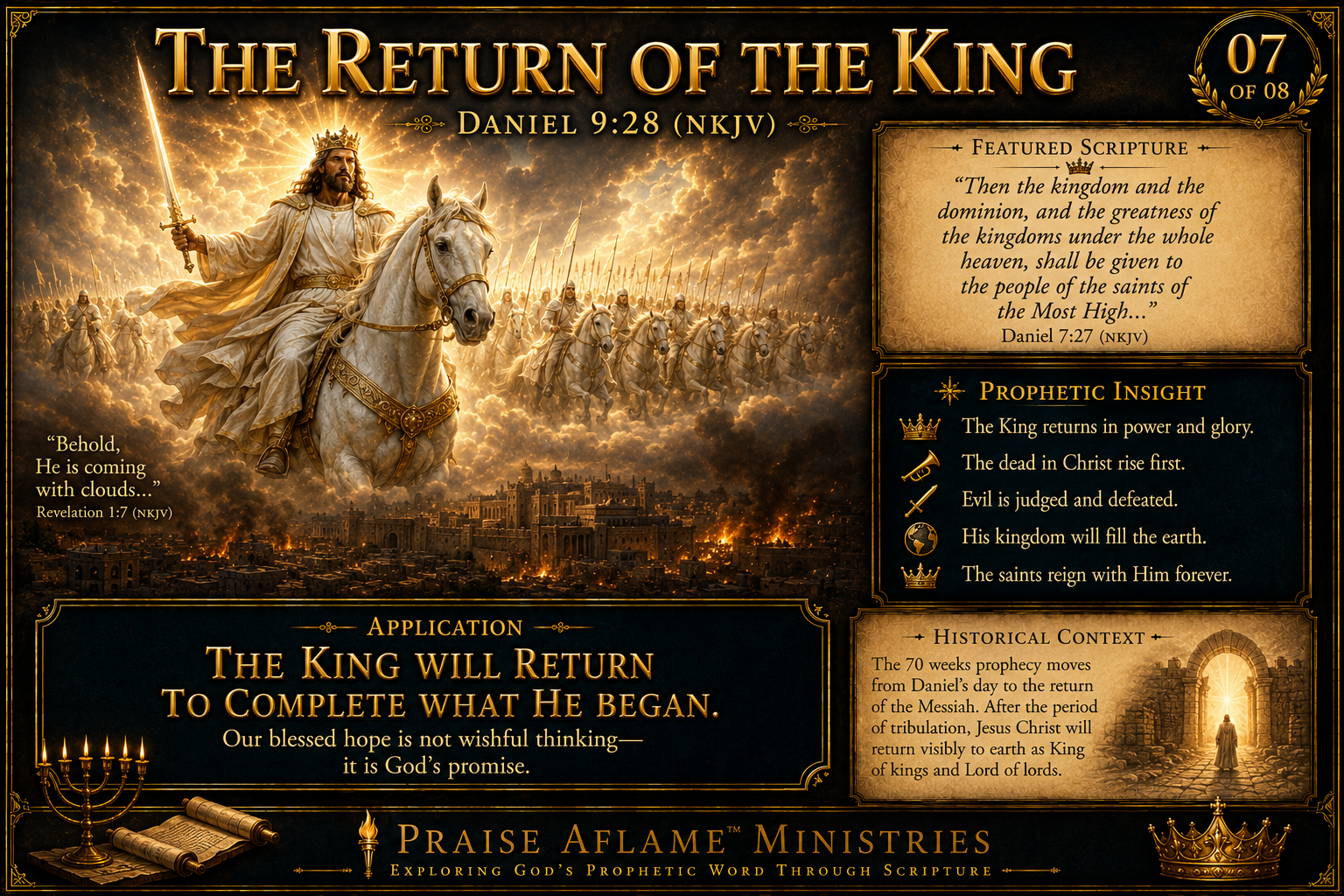
From the opening pages of Genesis to Revelation, the Bible tells one unfolding story pointing toward the visible return of Jesus Christ. Daniel saw it centuries before Christ was born: “I was watching in the night visions, and behold, One like the Son of Man, coming with the clouds of heaven!... Then to Him was given dominion and glory and a kingdom...” (Daniel 7:13–14, NKJV).
When Jesus came the first time, He entered the world quietly in a humble stable in Bethlehem. His second coming will be entirely different. John describes it with breathtaking detail: “Now I saw heaven opened, and behold, a white horse. And He who sat on him was called Faithful and True... and on His robe and on His thigh a name written: KING OF KINGS AND LORD OF LORDS.” (Revelation 19:11–16, NKJV).
Human empires—Babylon, Persia, Greece, Rome—eventually fade into history, but God's Kingdom is eternal. The return of Christ marks the end of every competing authority as He establishes perfect justice. Isaiah foresaw this Kingdom, stating, “Of the increase of His government and peace there will be no end.” (Isaiah 9:7, NKJV).
The return of Christ assures us that evil never has the final word. Every wrong will be made right, every injustice judged, and every tear wiped away. As the early church cried out in anticipation, “Even so, come, Lord Jesus!” (Revelation 22:20, NKJV), believers today await the glorious day when every prophecy finds its fulfillment.
STEP 8
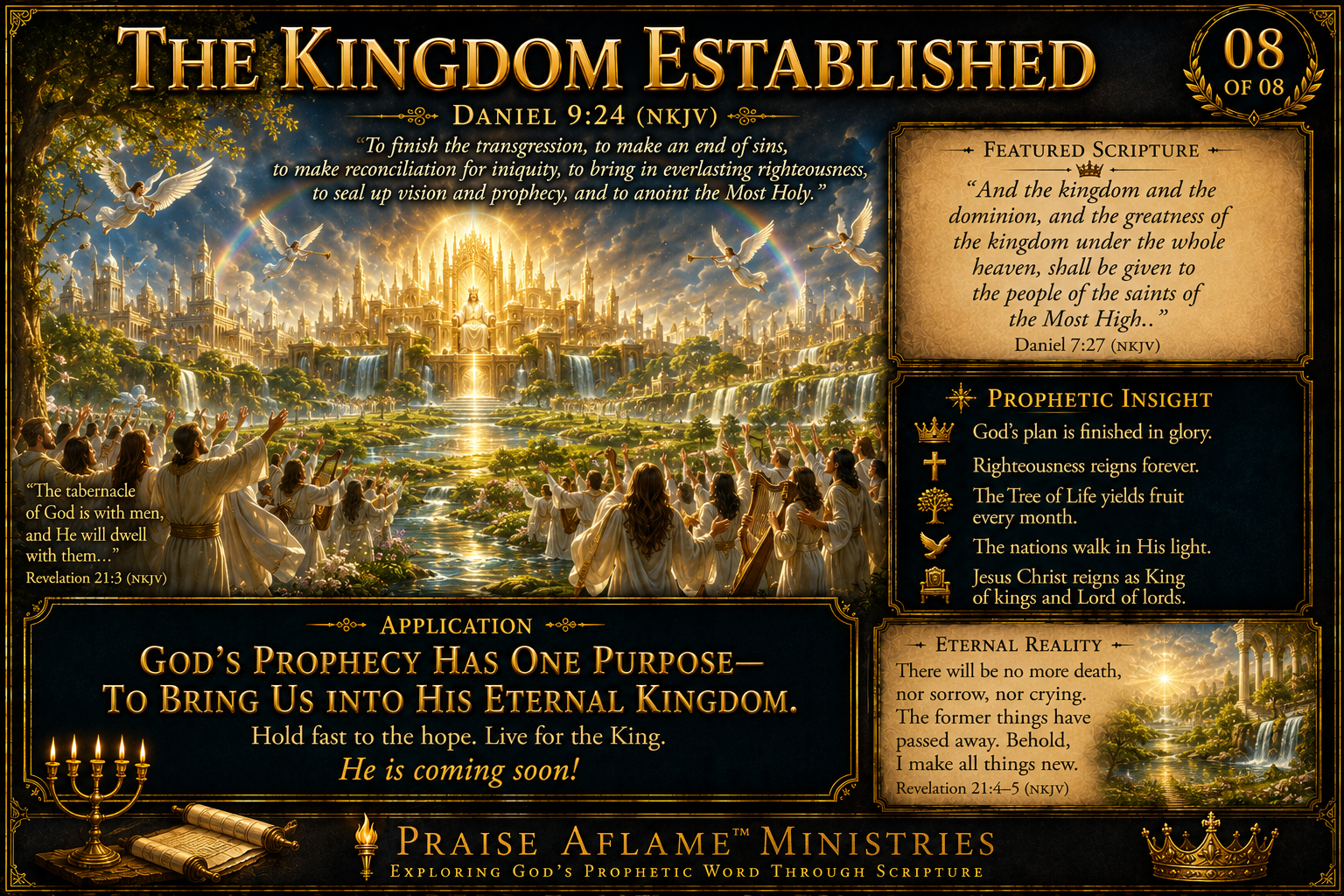
The Kingdom Established
The Kingdom That Shall Never End (Daniel 7:27; Revelation 21–22)
Every journey has a destination, and every prophecy has its appointed conclusion. Daniel saw that ultimate Kingdom when he wrote: “Then the kingdom and dominion, and the greatness of the kingdoms under the whole heaven, shall be given to the people, the saints of the Most High. His kingdom is an everlasting kingdom...” (Daniel 7:27, NKJV).
When Jesus began His earthly ministry, He proclaimed, “Repent, for the kingdom of heaven is at hand.” (Matthew 4:17, NKJV). His first coming inaugurated God's Kingdom through redemption, and His second coming brings that Kingdom to its glorious fulfillment. John saw this in a vision: “Now I saw a new heaven and a new earth, for the first heaven and the first earth had passed away.” (Revelation 21:1, NKJV).
“Behold, the tabernacle of God is with men, and He will dwell with them, and they shall be His people.” (Revelation 21:3, NKJV). From Genesis to Revelation, God's greatest desire has always been to dwell with His people. Furthermore, “And God will wipe away every tear from their eyes; there shall be no more death, nor sorrow, nor crying. There shall be no more pain...” (Revelation 21:4, NKJV). The greatest joy of eternity is seeing the face of Jesus Christ: “They shall see His face...” (Revelation 22:4, NKJV).
What humanity lost through Adam is fully restored through Jesus Christ. The curse is gone, death is defeated, and the Lamb reigns. As Scripture closes with the invitation, “And the Spirit and the bride say, 'Come!'...” (Revelation 22:17, NKJV) and Jesus' promise, “Surely I am coming quickly.” (Revelation 22:20, NKJV), believers echo John's prayer: “Even so, come, Lord Jesus.”