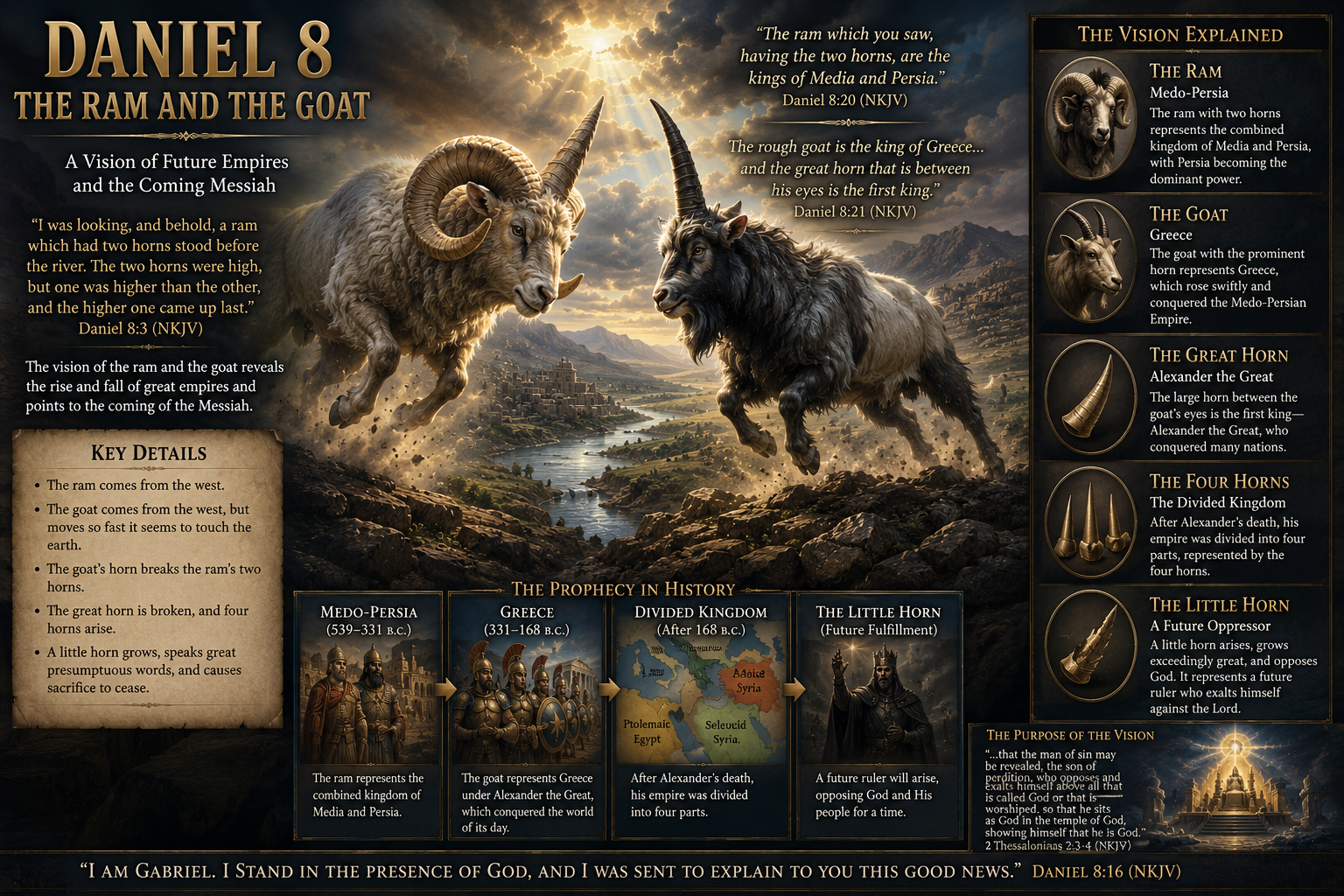
Daniel 8 — The Vision of the Ram and the Goat
God Reveals the Next Chapter of History
Daniel 8:1–27 (NKJV)
A Vision Unlike Any Other
Several years after receiving the vision of the four beasts, Daniel was given another extraordinary revelation. This time there were no lions. No bears. No winged leopards. Instead... God showed Daniel two animals that everyone in the ancient world understood—a ram and a goat.
At first glance the vision seems simple. But beneath the surface lies one of the most astonishing prophecies in the entire Bible. Unlike Daniel 7, where God revealed four world empires, Daniel 8 zooms in on two specific kingdoms and describes events that would occur hundreds of years before they happened.
The Ram
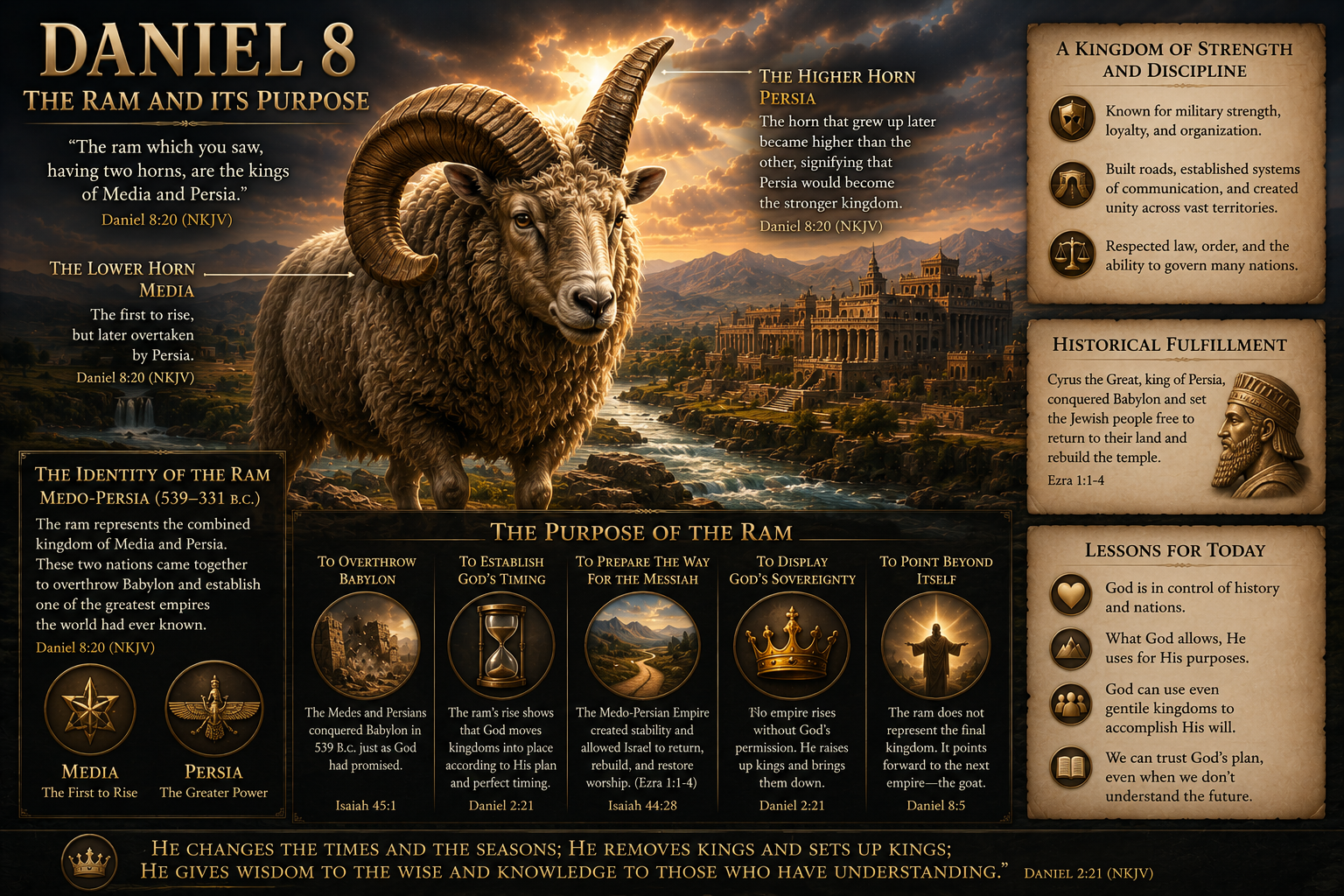
The Empire of Medo-Persia (Daniel 8:3–4, 20)
Daniel first saw a powerful ram standing beside a river. It had two horns. One horn was higher than the other, although it grew later. The ram charged westward, northward, and southward. No animal could stand against it.
The angel Gabriel explains it directly: “The ram which you saw, having the two horns—they are the kings of Media and Persia.” (Daniel 8:20 NKJV). The two horns represent the two nations that formed one empire. Although the Medes rose first, Persia eventually became the stronger kingdom, which is why one horn became larger.
Lesson: History unfolds exactly as God foretells. No empire rises without His sovereign appointment.
The Goat
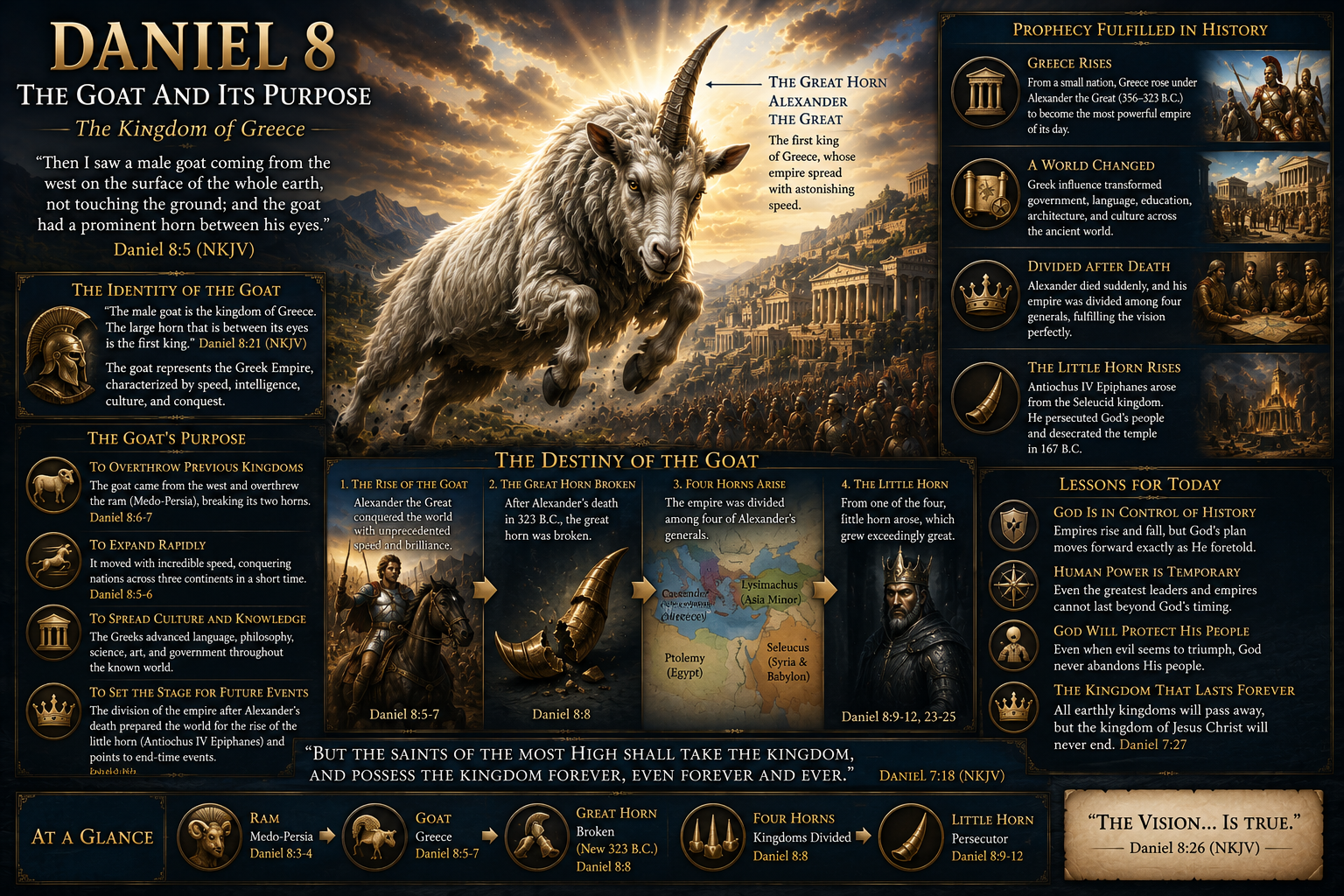
The Empire of Greece (Daniel 8:5–8, 21)
Out of the west comes a male goat, moving so fast that “it did not touch the ground” (Daniel 8:5 NKJV). It has one large horn between its eyes and charges directly toward the ram with unstoppable fury, breaking both its horns and trampling it.
The angel Gabriel identifies the male goat as the kingdom of Greece, and the large horn as its first king—Alexander the Great (Daniel 8:21). Alexander conquered the Medo-Persian Empire faster than anyone thought possible before dying unexpectedly at thirty-two.
Following his death, his empire was divided into four horns among his four generals (Cassander, Lysimachus, Seleucus, and Ptolemy), exactly as prophesied.
Then Comes the Little Horn
Just when Daniel thinks the vision is over, another horn begins to grow. It starts small, but becomes exceedingly great. It attacks God's people, opposes true worship, exalts itself, and desecrates the sanctuary.
Historically, scholars see an initial fulfillment in Antiochus IV Epiphanes, a Seleucid ruler who persecuted the Jews and desecrated the temple. Yet, he also serves as a foreshadowing of a future world ruler (the Antichrist) who will exalt himself against God before Christ returns.
Why Did God Reveal This?
Imagine living in Babylon. Medo-Persia had not yet risen, and Alexander the Great would not be born for nearly two hundred years. Yet God described these kingdoms in remarkable detail long before history unfolded so that His people would know that history is never an accident.
The same God who foretold the rise of Persia and Greece also knows every detail of our future.
Key Prophetic Symbols
🐏 Ram with Two Horns
Meaning: The combined Medo-Persian Empire, with Persia becoming the stronger power.
🐐 Male Goat
Meaning: The Greek Empire advancing with astonishing speed.
🦄 Great Horn
Meaning: Alexander the Great, the first king of Greece's empire.
📯 Four Horns
Meaning: The division of Alexander's empire among his four generals.
👑 Little Horn
Meaning: Historically fulfilled in Antiochus IV Epiphanes, while also foreshadowing a future ruler who opposes God.
A Final Thought
Daniel was not given this vision to satisfy curiosity about the future, but to strengthen the faith of God's people. The ram reminds us that great empires do not last forever; the goat reminds us that even the swiftest conquerors are subject to God's timetable.
The final word belongs to God. And that is the great message of Daniel 8: the Lord of history is also the Lord of our future.
The Vision is True
“The vision... is true.” — Daniel 8:26 (NKJV)