“How Long Will You Falter?”
Elijah confronted the people over their divided allegiance. If the LORD was God, they were to follow Him; if Baal was god, they were to follow Baal. See 1 Kings 18:20–21.
Prophets, Faith and Miracles • Exhibit 1 of 8
Elijah repaired the broken altar of the LORD, used twelve stones representing the tribes of Israel, prepared the sacrifice, saturated it with water, filled the trench and prayed. What followed became one of the most dramatic public demonstrations of God's power recorded in the Old Testament.
Featured Museum Artwork
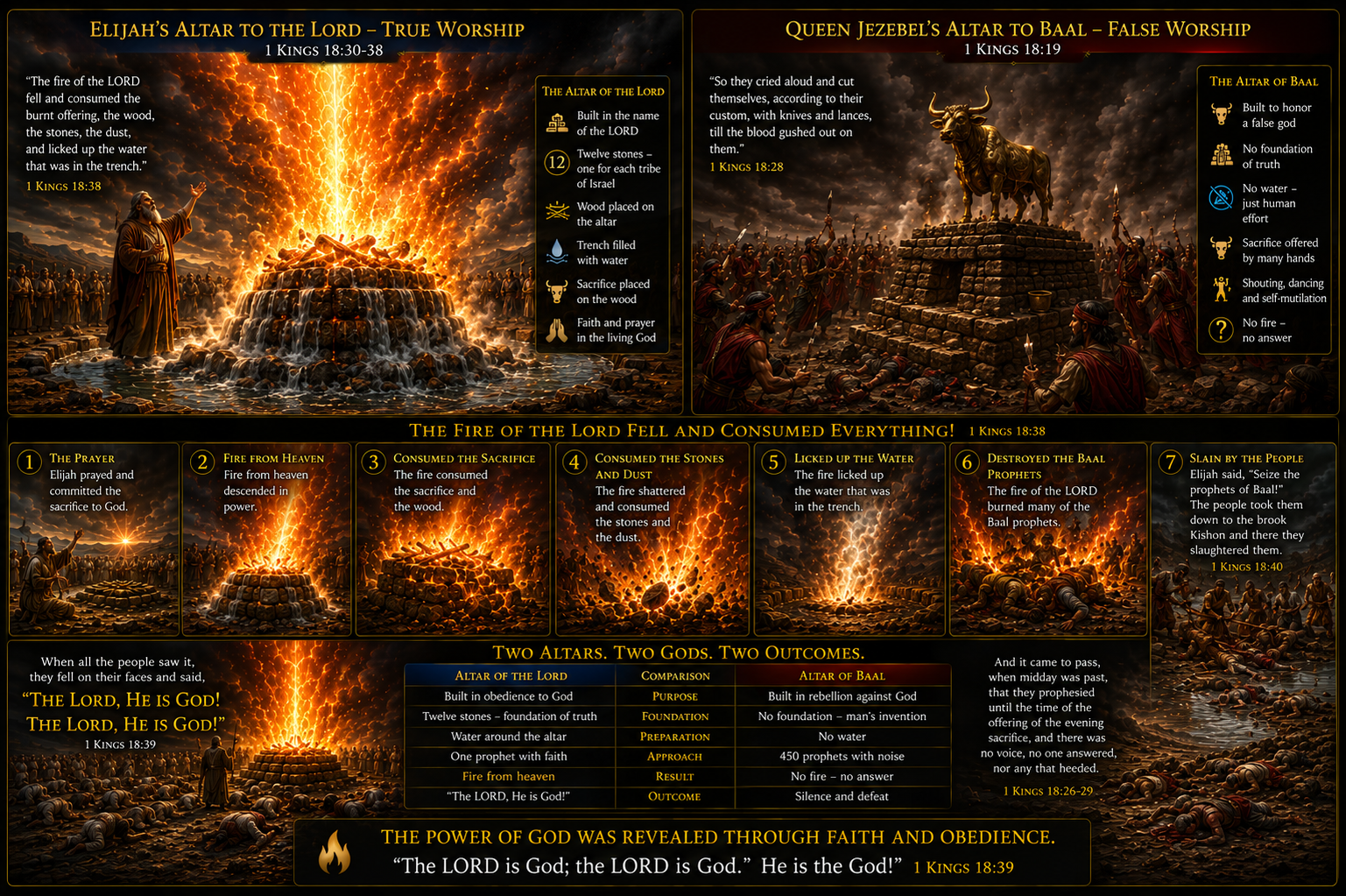
The confrontation was not merely a spectacle. Elijah challenged Israel's divided loyalty and arranged the test so that human manipulation could not explain the outcome.
Elijah confronted the people over their divided allegiance. If the LORD was God, they were to follow Him; if Baal was god, they were to follow Baal. See 1 Kings 18:20–21.
They called on Baal, cried aloud, leaped about the altar and cut themselves according to their custom, yet there was no voice and no answer. See 1 Kings 18:25–29.
Elijah repaired the altar with twelve stones according to the number of the tribes descended from Jacob. See 1 Kings 18:30–31.
Four waterpots were poured over the offering three separate times until water ran around the altar and filled the trench. See 1 Kings 18:32–35.
Elijah repaired the broken altar of the LORD.
He used twelve stones representing the tribes of Israel.
The wood was arranged and the bull was laid upon it.
Water was poured repeatedly over the sacrifice and wood.
The water flowed around the altar until the trench was filled.
Elijah prayed that Israel would know the LORD is God. See 1 Kings 18:36–37.
The fire consumed the burnt sacrifice, wood, stones and dust, and licked up the water. See 1 Kings 18:38.
The people fell on their faces and confessed that the LORD is God. See 1 Kings 18:39.
Afterward Elijah ordered them seized and taken to the Brook Kishon, where they were executed. See 1 Kings 18:40.
The fire from heaven did not consume the prophets of Baal. According to 1 Kings 18:38, it consumed the burnt sacrifice, wood, stones and dust and licked up the water in the trench. The prophets of Baal were seized and executed afterward in the separate event recorded in 1 Kings 18:40.
Elijah did not ask for fire merely to display power. His prayer was that the people would know the LORD is God and that God was turning their hearts back to Himself.
After Mount Carmel, Elijah entered one of the lowest moments of his life. The next exhibit follows him into the wilderness and to Horeb, where wind, earthquake and fire give way to the still small voice.