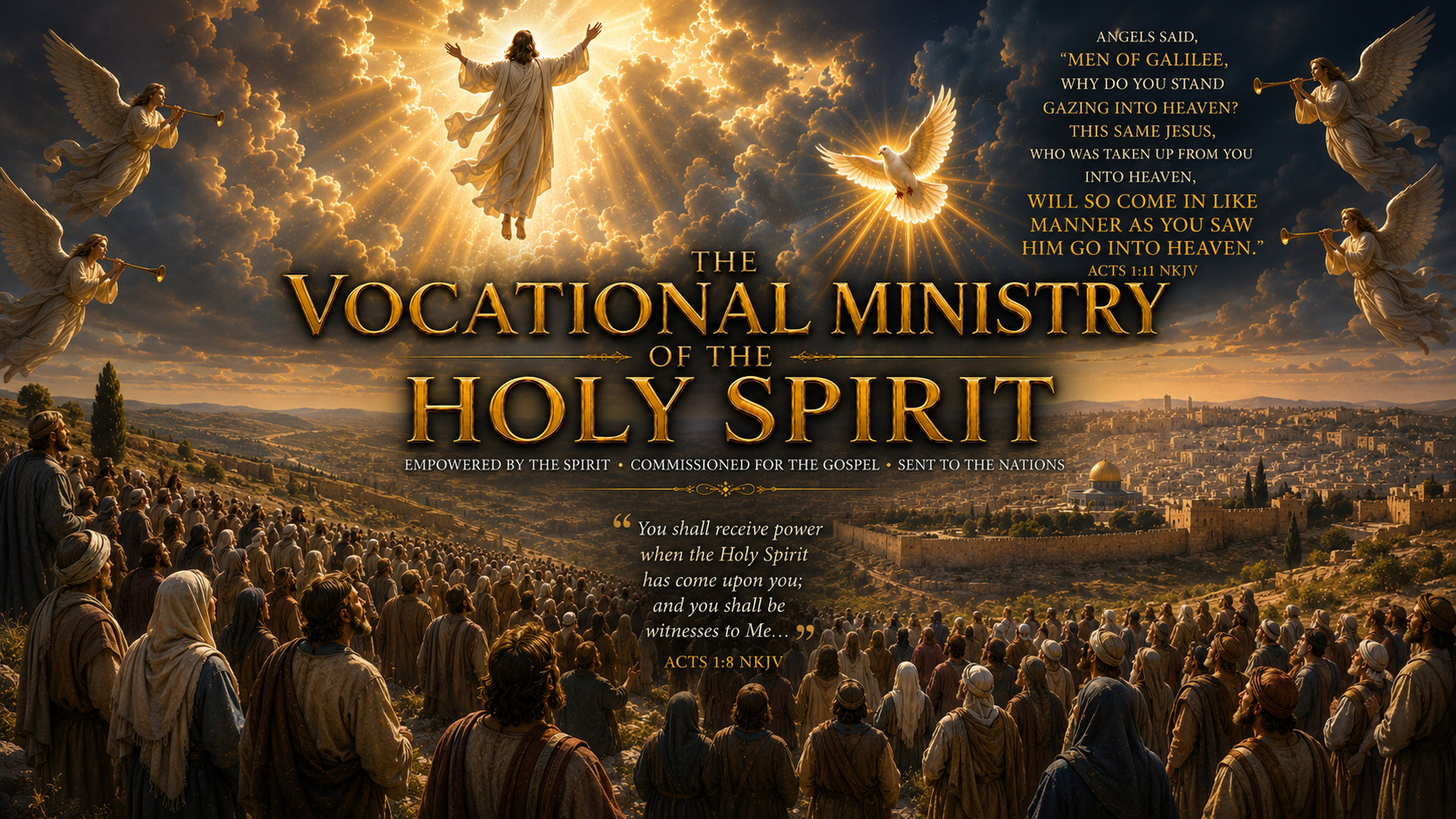
The Holy Spirit does more than transform the inward life of a believer. Luke reveals another essential dimension of the Spirit’s work: He empowers ordinary people to continue the mission of Jesus Christ.
The Spirit who gives life also gives power for witness.
Canadian Pentecostal theologian Roger Stronstad helped many readers see that Luke-Acts contains a distinctive theology of the Holy Spirit. Luke is not merely repeating Paul’s teaching in narrative form. He is emphasizing the Spirit’s vocational purpose—the Spirit equips and commissions God’s people for ministry.
What Does “Vocational” Mean?
The word vocational refers to calling, assignment, and service. In Luke-Acts, the Holy Spirit repeatedly comes upon people and enables them to speak, prophesy, witness, serve, and carry forward the purposes of God.
Stronstad’s central insight can be summarized this way: Luke’s presentation of the Holy Spirit is primarily charismatic and vocational. The Spirit empowers believers to participate in God’s mission.
Luke and Paul: Two Necessary Emphases
Luke and Paul do not oppose one another. They illuminate different dimensions of the same work of the Holy Spirit. Paul often explains how the Spirit gives life in Christ and forms Christlike character. Luke frequently explains how the Spirit empowers the people of God for mission.
Paul’s Emphasis
- New life in Christ
- Adoption as God’s children
- Sanctification
- The fruit of the Spirit
- Walking by the Spirit
- The Church as the body of Christ
Luke’s Emphasis
- Power for witness
- Prophetic speech
- Bold proclamation
- Signs and wonders
- Mission to the nations
- Continuing the ministry of Jesus
Paul helps us understand life in the Spirit. Luke helps us understand ministry in the Spirit.
Jesus Is the Model
Luke begins by showing that Jesus Himself carried out His ministry in the power of the Holy Spirit. At Nazareth, Jesus declared that the Spirit of the Lord was upon Him because He had been anointed to preach the Gospel, heal the brokenhearted, proclaim liberty, restore sight, and announce the acceptable year of the Lord.
Jesus did not merely teach His followers what to do. He showed them how ministry was to be carried out—through dependence upon the Holy Spirit.
From Jesus to the Church
The Gospel of Luke records what Jesus began to do and teach. The book of Acts records how the risen Christ continued His work through Spirit-empowered believers. The disciples were not told to begin the mission in their own strength. They were told to wait until they were clothed with power from on high.
Pentecost was not merely an inward spiritual experience. It was the commissioning of a witnessing community. The Spirit came, Peter proclaimed Christ, hearts were pierced, and about three thousand people responded to the Gospel.
The power of the Spirit penetrated hearts and opened people to transformation.
The Gospel Comes With Power
The good news is not advanced by persuasion alone. The Holy Spirit confirms the witness of Jesus through conviction, boldness, wisdom, prophetic insight, healing, deliverance, signs, and transformed lives.
The book of Acts shows the Gospel moving outward from Jerusalem into Judea, Samaria, and the nations. Each advance is connected to the activity and direction of the Holy Spirit.
Power to Speak
The Spirit gives ordinary believers courage and words to proclaim Jesus.
Power to Demonstrate
The Spirit confirms the Gospel through healing, deliverance, and signs.
Power to Transform
The Spirit convicts hearts and brings individuals and communities into new life.
Peter: A Life Transformed for Mission
Before Pentecost, Peter denied Jesus in fear. After Pentecost, he stood publicly and proclaimed that Jesus is both Lord and Christ. The Holy Spirit transformed a fearful disciple into a bold witness.
Acts also records extraordinary healings connected with Peter’s ministry. People brought the sick into the streets in hope that even his shadow might fall upon some of them. The emphasis is not that Peter possessed power in himself, but that the risen Christ was continuing His works through a Spirit-empowered servant.
The Prophethood of All Believers
Another major theme in Stronstad’s work is that the gift of the Spirit is not reserved for a spiritual elite. At Pentecost, Peter explained the outpouring through Joel’s promise: sons and daughters would prophesy, young and old would receive revelation, and the Spirit would be poured out upon servants.
This means the whole Church is invited into Spirit-empowered participation. Every believer has a place in the mission of God.
What This Means for Believers Today
The Church is not called merely to gather, receive teaching, sing, and return home. Believers are commissioned to carry the presence and message of Jesus into the world.
The Holy Spirit empowers believers to speak to the unbeliever, pray for the sick, encourage the broken, discern divine opportunities, confront darkness, serve with compassion, and proclaim that Jesus Christ is Lord.
The Spirit’s power is not given for display. It is given so that Jesus may be revealed.
A Commission, Not Merely an Experience
To be filled with the Holy Spirit is to be drawn into the mission of Jesus. We receive His presence, but we are also sent with His purpose. We are empowered to carry the Gospel in word, love, service, and the demonstration of God’s Kingdom.
The Holy Spirit equips ordinary believers to become extraordinary witnesses.
Further Study
Roger Stronstad developed these themes especially in The Charismatic Theology of St. Luke and The Prophethood of All Believers. His work encourages readers to hear Luke’s theology in its own voice and to recognize Luke-Acts as a Spirit-inspired pattern for the mission of the Church.
These insights should not be used to divide Luke from Paul. Together, their writings reveal a fuller picture: the Spirit saves, indwells, sanctifies, transforms, gifts, empowers, and sends the people of God.