Returning
Paul returned to regions where the Gospel had previously been preached and believers had already begun following Christ.
THIRD MISSIONARY JOURNEY
Paul begins his Third Missionary Journey by traveling through the regions of Galatia and Phrygia.
These were not simply new destinations. Paul was returning to communities where the Gospel had already been proclaimed and where believers needed continued encouragement, teaching and spiritual strengthening.
“After he had spent some time there, he departed and went over the region of Galatia and Phrygia in order, strengthening all the disciples.”
— Acts 18:23, NKJV
FEATURED MUSEUM ARTWORK
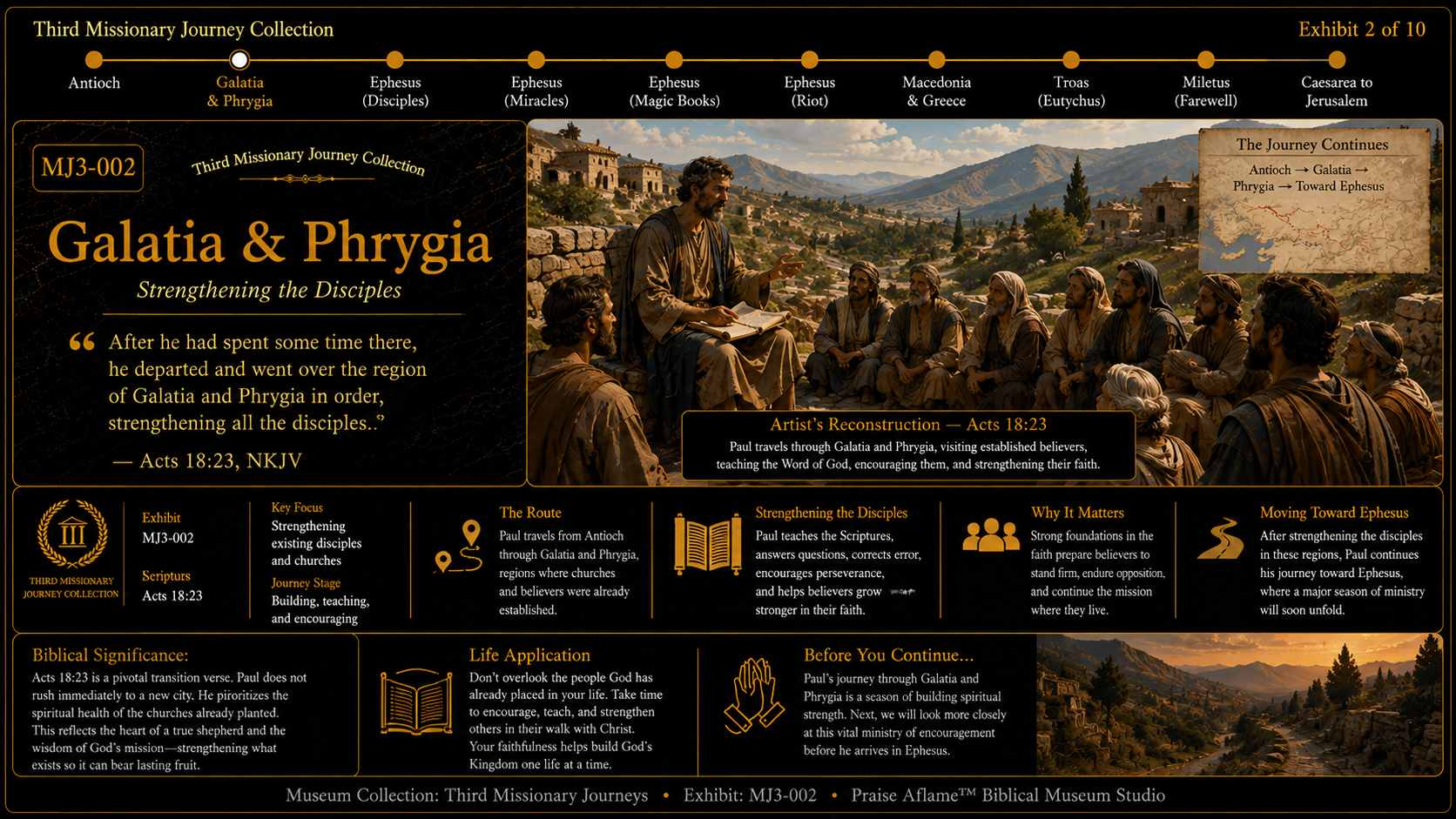
This museum artwork presents Paul traveling through the regions of Galatia and Phrygia during the opening stage of his Third Missionary Journey. The landscape, settlements and individual figures are interpretive, while the biblical record tells us that Paul traveled through these regions strengthening the disciples.
THE BIBLICAL RECORD
Acts gives us only a brief description of this stage of Paul's journey, but the wording is significant.
Paul traveled through the region “in order.” This suggests a deliberate journey through areas where churches and groups of believers had already been established.
His purpose was not merely to pass through these communities. Scripture specifically tells us that he was strengthening all the disciples.
Paul returned to regions where the Gospel had previously been preached and believers had already begun following Christ.
These believers needed continued instruction in the Scriptures and a deeper understanding of their faith.
Following Christ in the ancient world could bring opposition, hardship and social pressure. Paul's presence would have encouraged believers to remain faithful.
Paul's ministry was not only about establishing churches. He repeatedly returned to strengthen the people who had already believed.
ANCIENT TRAVEL PERSPECTIVE
633 km / 412 miles
Primarily overland travel through the rugged interior of Asia Minor.
Today, a journey of this distance by automobile might take only several hours.
For Paul and his companions, this was an entirely different undertaking.
Traveling largely on foot, they could expect to cover roughly 25–32 km (15–20 miles) on a good day's journey. A trip of approximately 633 km could therefore require around three weeks of actual travel under favorable conditions.
But those days were not spent simply walking from one destination to another.
The journey into Asia Minor meant climbing through difficult terrain and mountain routes, including approaches through the Taurus region.
Travelers needed provisions and dependable sources of water while moving between towns and settlements.
Heat, rain, flooding and seasonal conditions could slow travel or make certain routes considerably more difficult.
Isolated roads could expose travelers to robbers, dangerous river crossings and other hazards of the countryside.
Paul did not travel 412 miles simply to arrive at another location.
He traveled that distance to strengthen believers, teach the Scriptures and encourage churches established during earlier missionary work.
WALKING THE ANCIENT WORLD
A modern traveler can cover hundreds of miles in a comfortable automobile in only a few hours.
Paul experienced those same miles one step at a time.
Day after day meant walking roads and trails, climbing through difficult terrain, locating water, finding food and shelter, enduring changing weather, and continuing toward communities that might still be many days away.
Then, after finally arriving, Paul's work began.
He taught. He encouraged believers. He reasoned from the Scriptures. He strengthened churches. And eventually he began walking toward the next destination.
Paul's missionary journeys were not simply lines connecting cities on a map.
Every mile represented time, physical effort, uncertainty and perseverance in carrying the Gospel from one community to another.
LIFE APPLICATION
Paul's example reminds us that ministry does not end when someone first hears the Gospel.
Believers need encouragement. They need teaching. They need fellowship. And sometimes they simply need someone willing to make the journey to stand beside them.
Who has God placed in your life that you could strengthen and encourage in their walk with Christ?
CONTINUE THE JOURNEY
Paul's journey now carries him toward one of the most important ministry centers of his missionary work: Ephesus.
There Paul will encounter disciples who know only the baptism of John, teach extensively, witness extraordinary works of God and remain in the region for an extended period.