Missionary Journeys Collection Exhibit 8 of 10

Missionary Journeys Collection

MJ-008

Lystra

The Power of God Confronts Idolatry and Persecution

Miracle • Misunderstanding • Persecution • Perseverance

“Then with a loud voice he said, ‘Stand up straight on your feet!’ And he leaped and walked.”— Acts 14:10, NKJV

Welcome to the Exhibit

From Miracle to Mob Violence

Lystra contains one of the most dramatic reversals in Paul’s First Missionary Journey. A man unable to walk from birth is healed, and the crowd becomes convinced that Paul and Barnabas are gods appearing in human form.

Paul and Barnabas urgently reject the worship and point the people toward the living God. Yet shortly afterward, opponents arrive from Antioch and Iconium, the crowd turns against Paul, and he is stoned and dragged outside the city.

Journey Orientation

Where Are We in Paul’s Journey?

Current Stop: Lystra

The Praise Aflame™ Biblical Museum & Resource Centre

Missionary Journeys Permanent Collection

Lystra

Acts 14:8–20

ExhibitMJ-008
Approximate DateMid-First Century AD
Ancient RegionLycaonia
Journey RoleHealing and persecution

Biblical Significance: Lystra is where Paul healed a man unable to walk from birth, the crowd attempted to worship Paul and Barnabas, and Paul was later stoned and left for dead before continuing the mission.
The Biblical Record

Acts 14:8–20

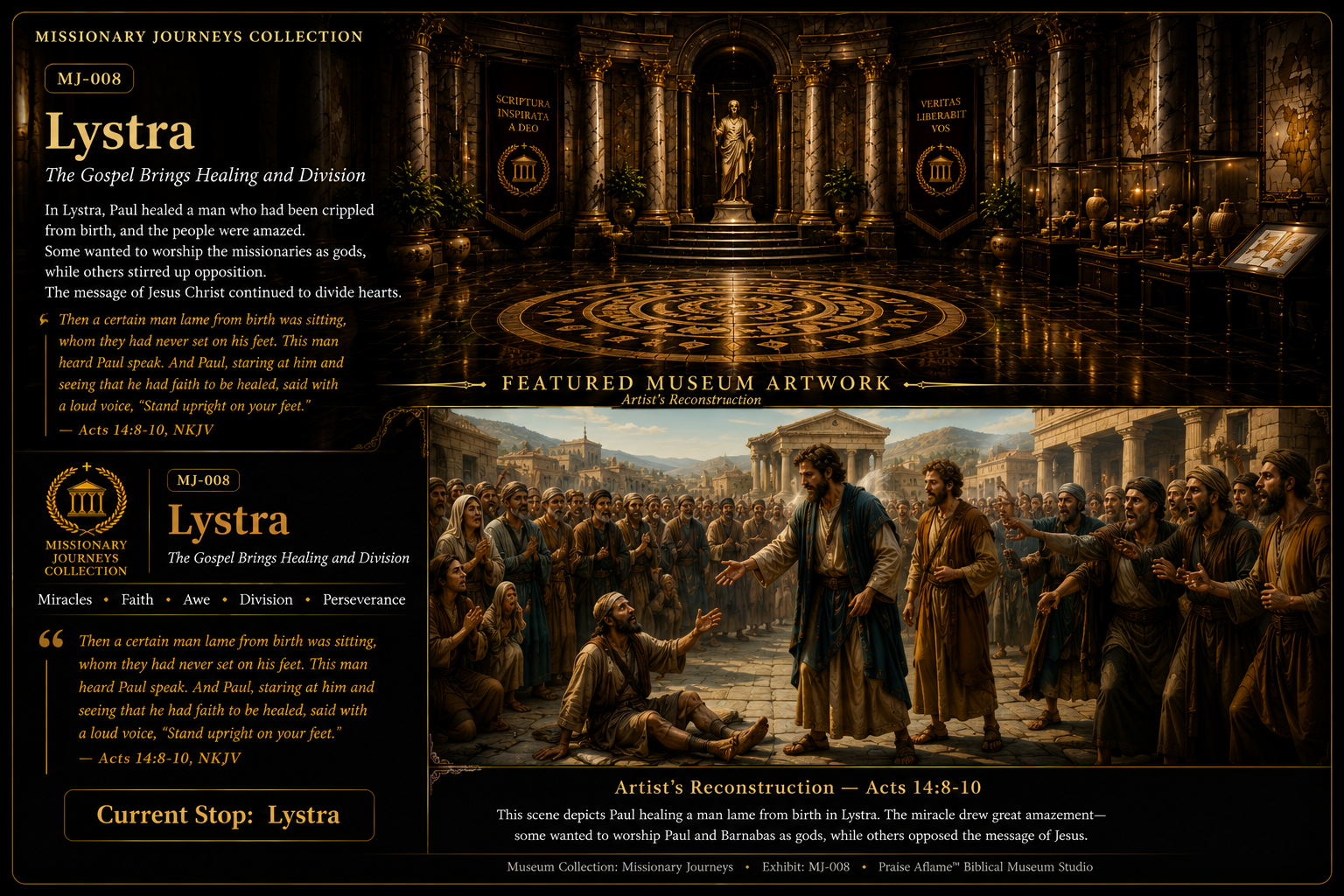
At Lystra, Paul saw a man who had been unable to walk from birth. Seeing that he had faith to be healed, Paul commanded him to stand, and the man leaped and walked.

The crowd concluded that the gods had come down in human form, calling Barnabas Zeus and Paul Hermes. Paul and Barnabas tore their clothes and pleaded with the people to turn from useless idols to the living God.

Later, opponents from Antioch and Iconium persuaded the crowd against Paul. He was stoned, dragged outside the city, and left for dead. When the disciples gathered around him, he rose and entered the city.

Summary of Acts 14:8–20

What Happened in Lystra?

Seven Movements in the Story

01

A Miraculous Healing

Paul heals a man who had never walked.

02

A Dangerous Misunderstanding

The crowd identifies Barnabas as Zeus and Paul as Hermes.

03

Stopping Idolatry

Paul and Barnabas tear their clothes and stop the crowd from sacrificing to them.

04

Pointing to the Living God

Paul urges the people to turn from useless things to the Creator.

05

Opposition Arrives

Jews from Antioch and Iconium persuade the crowd against Paul.

06

Paul Is Stoned

Paul is dragged outside the city and left for dead.

07

The Mission Continues

Paul rises, reenters the city, and later continues with Barnabas to Derbe.

A Striking Reversal

From Worship to Stoning

Few scenes in Acts reveal the instability of public approval more clearly than Lystra. One moment the crowd wants to sacrifice to Paul and Barnabas. Soon afterward, Paul is being stoned.

The missionaries could not build their identity on applause. Their calling had to remain anchored in the Lord who sent them.

Historical Background

Lystra in the Lycaonian World

A Roman Colony

Lystra became a Roman colony in the Augustan period. Its population existed within a mixed cultural world that included local Lycaonian traditions and Roman influence.

Why Zeus and Hermes?

Acts specifically says the crowd spoke in the Lycaonian language and identified Barnabas with Zeus and Paul with Hermes. This shows the missionaries were entering a local religious culture very different from the synagogue settings of earlier stops.

Archaeologist’s Note

Ancient Lystra is associated with the mound commonly identified as Zoldra Höyük in central Türkiye. Compared with several other Pauline cities, fewer monumental remains are visible to modern visitors.

Museum Note: The featured Lystra artwork is an educational reconstruction. It does not claim that the precise buildings shown have been archaeologically verified.

Why This Stop Matters

The Gospel Is Not About the Messenger

The healing at Lystra could easily have turned the attention toward Paul and Barnabas. Instead, they refused the worship and redirected the crowd toward the living God.

Lystra therefore teaches both humility and perseverance: refuse to accept glory that belongs to God, and refuse to abandon the mission when human approval turns into hostility.

Curator’s Reflection

Do Not Build Your Calling on Applause

In Lystra, the crowd moved from wanting to worship Paul to participating in violence against him.

Human praise can change quickly. The faithfulness of God does not.

Paul’s response reminds us that the messenger must never become more important than the message.

— Praise Aflame™ Biblical Museum & Resource Centre

Life Application

Stay Humble in Success and Steady in Opposition

Lystra presents two dangers: being lifted up by praise and being crushed by rejection. Paul faced both in the same city.

Consider: What keeps your identity anchored in Christ when people either celebrate what you do or strongly reject it?

Before You Continue...

What Have You Received?

Every exhibit is designed to encourage you to return to Scripture with greater understanding, deeper confidence, and renewed wonder.

Take a Quiet Moment: What did Lystra teach you about miracles, humility, false worship, persecution, perseverance, and remaining faithful when circumstances change suddenly?

Continue Your Journey

Next Destination: Derbe

You have now completed Exhibit MJ-008 — Lystra. Paul and Barnabas now continue to Derbe.

There the tone changes dramatically. After the violence at Lystra, Acts simply tells us that they preached the gospel and made many disciples.

Carry the Word With You

“Your word is a lamp to my feet and a light to my path.”

Psalm 119:105, NKJV