Missionary Journeys Collection Exhibit 6 of 10

Missionary Journeys Collection

MJ-006

Pisidian Antioch

Paul Proclaims God’s Saving Work in Jesus Christ

“Men and brethren, sons of the family of Abraham, and those among you who fear God, to you the word of this salvation has been sent.” — Acts 13:26, NKJV

Welcome to the Exhibit

One of Paul’s Great Recorded Sermons

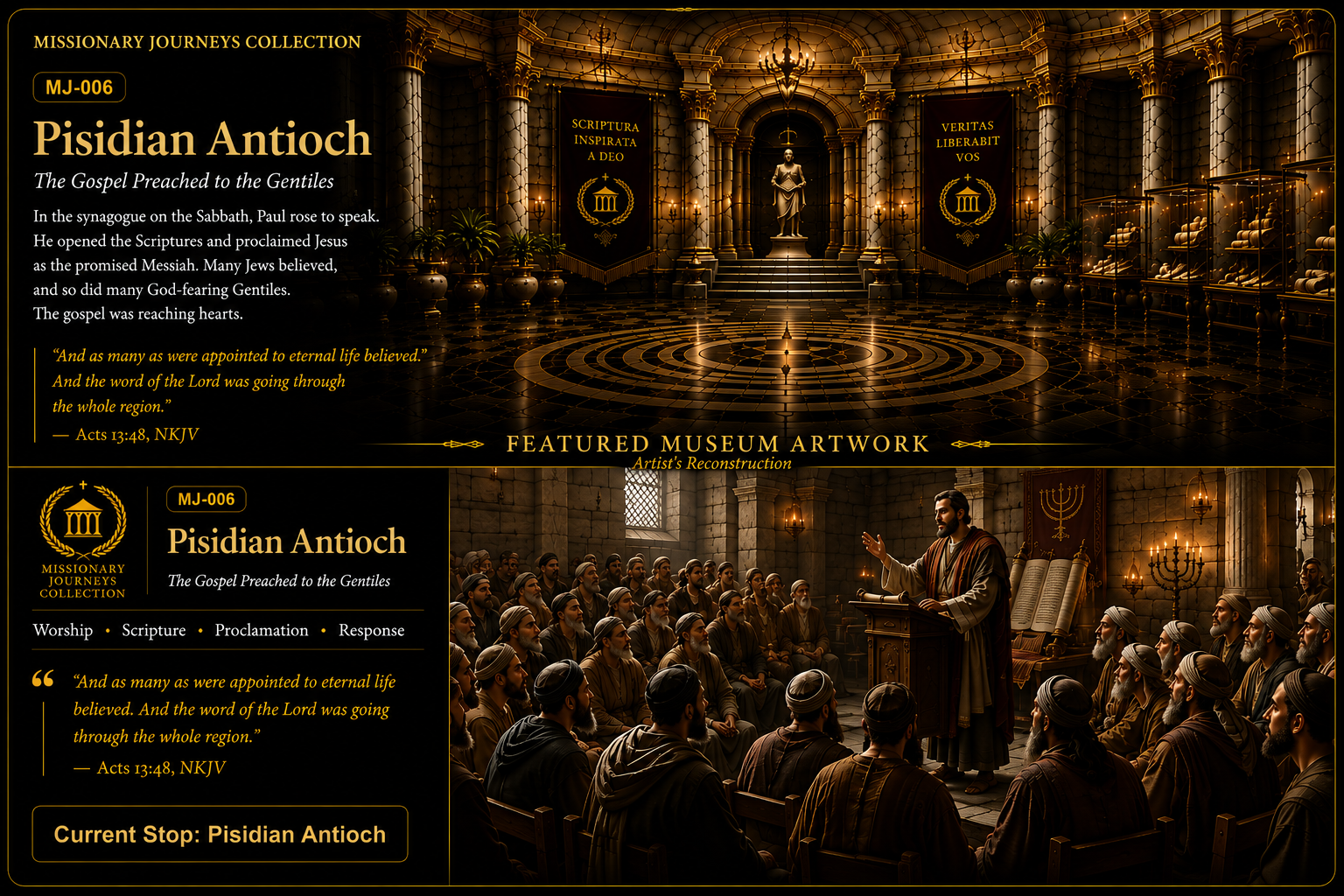
From Perga, Paul and Barnabas travelled inland to Pisidian Antioch. On the Sabbath they entered the synagogue, sat down, and were invited to speak a word of exhortation to the people.

Paul stood and traced God’s work through Israel’s history, from the fathers and the Exodus to David, then proclaimed Jesus as the promised Savior and declared forgiveness and justification through Him.

Journey Orientation

Where Are We in Paul’s Journey?

Current Stop: Pisidian Antioch

The Praise Aflame™ Biblical Museum & Resource Centre

Missionary Journeys Permanent Collection

Pisidian Antioch

Acts 13:14–52

Exhibit MJ-006
Approximate Date Mid-First Century AD
Ancient Region Southern Galatia
Modern Location Near Yalvaç, Isparta Province

Biblical Significance: Pisidian Antioch is the setting for Paul’s major synagogue sermon in Acts 13, where he proclaims Jesus as the promised Savior and announces forgiveness and justification through Him.
The Biblical Record

Acts 13:14–52

Paul begins with Israel’s story, recalls God’s choice of the fathers, the Exodus, the wilderness, the judges, Saul, and David, and then declares that from David’s seed God raised up for Israel a Savior — Jesus.

He proclaims Jesus’ death and resurrection, announces forgiveness of sins through Him, and declares that everyone who believes is justified from things from which the law of Moses could not justify them.

Summary of Acts 13:16–41

Paul’s Message

How the Sermon Unfolds

01

God’s Work in Israel

Paul begins by retelling Israel’s history as the work of God — choosing, delivering, leading, judging, and establishing.

02

David and the Promise

Paul highlights David and connects the promise to Jesus, declaring Him to be the Savior raised up from David’s seed.

03

Death and Resurrection

The heart of the message is the death and resurrection of Jesus, interpreted in light of the Scriptures.

04

Forgiveness and Justification

Paul announces that through Jesus forgiveness is proclaimed and that believers are justified through Him.

The Response

Interest, Joy, Opposition, and Expansion

The City Wanted to Hear More

After the synagogue gathering, many of the Jews and devout proselytes followed Paul and Barnabas, who urged them to continue in the grace of God.

On the next Sabbath, Acts says that almost the whole city came together to hear the Word of God.

Opposition Intensified

The large response also stirred jealousy and contradiction. Paul and Barnabas answered boldly and declared that they were turning to the Gentiles.

The Gentiles rejoiced and glorified the Word of the Lord, while persecution was stirred up against the missionaries.

A Mission Expands

A Light to the Gentiles

In Acts 13:47, Paul and Barnabas cite the prophetic language of Isaiah concerning being a light to the Gentiles and bringing salvation to the ends of the earth.

This moment is one of the clearest transitions in the First Missionary Journey. The gospel is not confined to one ethnic group or one city. The mission is expanding outward.

Historical Background

Pisidian Antioch in the Roman World

A Roman Colony

Pisidian Antioch held an important place in the Roman administration of the region. Its civic life reflected Roman political, military, and cultural influence.

This makes the city a significant setting for Paul’s message: the gospel was moving into influential urban centres of Asia Minor.

A City Connected by Roads

The city stood along important routes connecting the interior regions of Asia Minor. Travel to and from Pisidian Antioch involved difficult inland terrain but opened the way toward Iconium, Lystra, and Derbe.

The missionary journey was now firmly established in the inland world of southern Galatia.

Archaeologist’s Note

The archaeological site of Antioch of Pisidia preserves remains from the Roman city, including monumental civic and religious spaces that help visitors appreciate the scale and character of the ancient centre.

  • Roman civic architecture
  • Monumental streets and public spaces
  • Temple precincts
  • Theatre remains
  • Later Christian structures
  • Extensive urban foundations

Museum Note: The surviving remains represent multiple centuries of occupation. They help us understand the city Paul visited, but individual structures should only be connected to Paul’s visit where evidence supports it.

Explore Pisidian Antioch Today

The ruins of Antioch of Pisidia lie near modern Yalvaç in Isparta Province, Türkiye.

Ancient City
Antioch of Pisidia
Ancient Region
Southern Galatia
Modern Province
Isparta
Journey Role
Major synagogue sermon
View Pisidian Antioch on Google Maps

Did You Know?

Four Details That Shape the Story

01

Paul Begins With Israel’s Story

His sermon is rooted in the history of God’s dealings with Israel before moving to Jesus.

02

Jesus Is Linked to David

Paul presents Jesus as the promised Savior arising from the line of David.

03

The Whole City Gathered

Acts says that nearly the whole city assembled the next Sabbath to hear the Word of God.

04

The Disciples Were Filled With Joy

Even after persecution and expulsion, Acts says the disciples were filled with joy and with the Holy Spirit.

Why This Stop Matters

The Gospel Is Explained, Received, and Opposed

Pisidian Antioch is one of the clearest examples in Acts of the missionary message being fully explained. Paul does not merely announce Jesus; he places Him within the unfolding story of God’s promises.

The response is equally important. Some receive the message with joy, while others resist it. Yet the Word continues to spread throughout the region.

Curator’s Reflection

Truth Can Be Rejected Without Being Defeated

Pisidian Antioch presents both extraordinary interest and intense opposition. The same message that brought joy to many also provoked resistance.

Paul and Barnabas did not measure the truth of the message by the reaction of the crowd. They continued to proclaim what they had received.

Rejection can close one door without ending the mission.

The gospel moved beyond opposition and continued spreading through the region.

— Praise Aflame™ Biblical Museum & Resource Centre

Life Application

Know the Story You Are Sharing

Paul’s sermon shows how powerful it can be to understand the larger biblical story. He connects promise, history, prophecy, Jesus, resurrection, forgiveness, and faith.

Consider: If someone asked you why Jesus matters, could you explain how He fits into the larger story of Scripture?

Before You Continue...

What Have You Received?

Every exhibit is designed to encourage you to return to Scripture with greater understanding, deeper confidence, and renewed wonder.

Take a Quiet Moment: What did Pisidian Antioch teach you about explaining the gospel, responding to opposition, and continuing faithfully when people react differently to the same truth?

Continue Your Journey

Next Destination: Iconium

You have now completed Exhibit MJ-006 — Pisidian Antioch. Paul and Barnabas now continue eastward to Iconium.

There they will again enter the synagogue, speak boldly, see many Jews and Greeks believe, and face another serious threat of violence.

Carry the Word With You

“Your word is a lamp to my feet and a light to my path.”

Psalm 119:105, NKJV