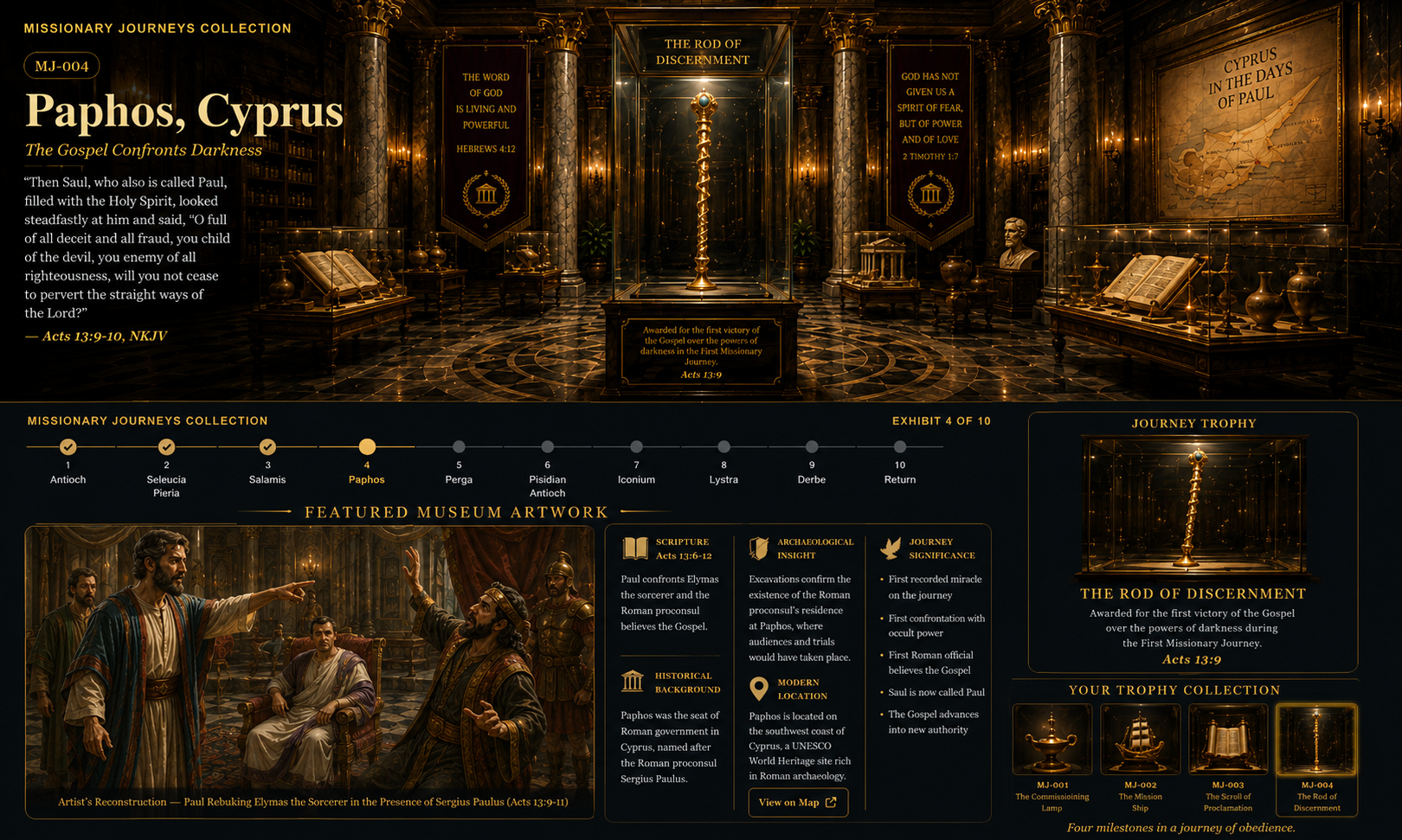
Missionary Journeys Collection Exhibit 4 of 10

Missionary Journeys Collection

MJ-004

Paphos, Cyprus

The Gospel Confronts Opposition Before a Roman Proconsul

“Then Saul, who also is called Paul, filled with the Holy Spirit...” — Acts 13:9, NKJV

Welcome to the Exhibit

A Turning Point on Cyprus

After travelling across Cyprus from Salamis, Paul, Barnabas, and John Mark reached Paphos on the western side of the island. Here the mission moved from synagogue proclamation into the presence of Roman political authority.

Acts 13:6–12 records a dramatic encounter involving Sergius Paulus, the Roman proconsul, and Elymas the sorcerer. The proconsul wanted to hear the Word of God, but Elymas attempted to turn him away from the faith. Paul, filled with the Holy Spirit, confronted the opposition.

Journey Orientation

Where Are We in Paul’s Journey?

Current Stop: Paphos, Cyprus

The Praise Aflame™ Biblical Museum & Resource Centre

Missionary Journeys Permanent Collection

Paphos, Cyprus

Acts 13:6–12

Exhibit MJ-004
Approximate Date Mid-First Century AD
Ancient Location Nea Paphos, Roman Cyprus
Modern Location Paphos, Cyprus

Biblical Significance: At Paphos, Sergius Paulus requested to hear the Word of God. Elymas opposed the mission, Paul confronted him while filled with the Holy Spirit, and the proconsul believed.
The Biblical Record

Acts 13:6–12

The missionaries crossed Cyprus to Paphos, where they encountered Bar-Jesus, also called Elymas, a Jewish sorcerer and false prophet. Sergius Paulus, the proconsul, summoned Barnabas and Saul because he wanted to hear the Word of God.

Elymas resisted them and tried to turn the proconsul away from the faith. Paul, filled with the Holy Spirit, confronted him, and Elymas became temporarily unable to see. The proconsul, seeing what had happened, believed and was astonished at the teaching of the Lord.

Summary of Acts 13:6–12

Biblical Context

Three People, Three Responses

Sergius Paulus Wanted to Hear

Acts describes Sergius Paulus as the Roman proconsul of Cyprus. Rather than dismissing the missionaries, he summoned Barnabas and Saul because he desired to hear the Word of God.

His response is significant. The gospel has now reached a representative of Roman provincial authority, and Luke records that he believed after witnessing the confrontation and hearing the teaching of the Lord.

Elymas Tried to Turn Him Away

Elymas stood in direct opposition to the missionary message. The issue was not simply disagreement; Acts says he attempted to turn the proconsul away from the faith.

Paul’s response is presented as Spirit-filled confrontation. The narrative emphasizes that spiritual opposition did not stop the mission from advancing.

A Name Visitors Notice

Saul, Who Also Is Called Paul

Acts 13:9 introduces a wording that becomes important for the remainder of the book: “Saul, who also is called Paul.” From this point forward, Luke ordinarily refers to him as Paul.

The text does not describe a dramatic renaming ceremony at Paphos. Rather, Luke identifies both names at this pivotal moment as the mission moves increasingly into the Greco-Roman world.

Historical Background

Paphos in the Roman World

A Centre of Roman Administration

In the Roman period, Nea Paphos served as an important administrative centre on Cyprus. This helps explain why Acts places the proconsul Sergius Paulus at Paphos.

The setting represents a major transition in the journey: the message that began in the church at Antioch is now being heard within the political world of Rome.

A City With Deep Religious Traditions

The wider Paphos region was strongly associated with the ancient cult of Aphrodite. The religious landscape of Cyprus therefore included long-established pagan traditions alongside Jewish communities and Roman civic life.

Acts presents the gospel entering this complex world without losing its focus: the Word of God is proclaimed, opposition arises, and the mission continues.

Archaeologist’s Note

The archaeological remains of Paphos reveal a substantial ancient city with elite residences, civic structures, theatres, fortifications, tombs, and richly decorated mosaic floors.

  • Roman villas with elaborate mosaics
  • Ancient theatre remains
  • Palatial and civic architecture
  • Fortifications and urban remains
  • The Tombs of the Kings necropolis

Museum Note: Surviving structures span several periods. They help us understand the scale and character of ancient Paphos, but individual ruins should not automatically be identified with specific people or events in Acts unless the evidence supports that conclusion.

Explore Paphos Today

Ancient Nea Paphos is preserved within the modern city of Paphos on the western side of Cyprus. The archaeological area is recognized internationally for its exceptional remains and Roman-period mosaics.

Ancient City
Nea Paphos
Island
Cyprus
Modern City
Paphos
Journey Role
Final major stop on Cyprus
View Paphos on Google Maps

Did You Know?

Four Details That Shape the Story

01

A Roman Proconsul Listened

Sergius Paulus deliberately summoned the missionaries because he wanted to hear the Word of God.

02

Elymas Opposed the Message

Acts portrays Elymas as actively attempting to turn the proconsul away from the faith.

03

Paul Was Filled With the Holy Spirit

Paul’s confrontation with Elymas is explicitly connected by Luke with the filling of the Holy Spirit.

04

Luke Begins Using the Name Paul

Acts 13:9 identifies Saul as Paul, and the name Paul becomes Luke’s usual designation for him afterward.

Why This Stop Matters

Opposition Did Not Stop the Word

Paphos is the first major confrontation recorded on this missionary journey. A powerful man wants to hear the Word of God while another man tries to prevent him from receiving it.

Yet the attempt to obstruct the message becomes part of the very event through which Sergius Paulus witnesses the authority of the mission and responds in faith.

Curator’s Reflection

Truth Does Not Need Darkness to Cooperate

Paphos reminds us that an open door does not mean there will be no resistance. Sergius Paulus wanted to hear the Word of God, yet Elymas immediately tried to interfere.

Paul did not retreat from the opposition. Filled with the Holy Spirit, he addressed it directly and continued the mission.

Opposition can stand in front of the message, but it cannot become greater than the God who sent it.

The result is striking: the man Elymas tried to turn away became the man Luke records as believing.

— Praise Aflame™ Biblical Museum & Resource Centre

Life Application

Discern What Is Helping or Hindering Truth

Paphos presents two very different responses to the Word of God: one person wants to hear it; another wants to prevent him from hearing it.

Consider: When you encounter competing voices, what helps you return to Scripture, test what you are hearing, and remain anchored in truth?

Before You Continue...

What Have You Received?

Every exhibit is designed to encourage you to return to Scripture with greater understanding, deeper confidence, and renewed wonder.

Take a Quiet Moment: What did Paphos teach you about spiritual opposition, discernment, the Holy Spirit, and the power of the Word of God?

Continue Your Journey

Next Destination: Perga in Pamphylia

You have now completed Exhibit MJ-004 — Paphos. Paul and his companions now leave Cyprus and sail north toward the coast of Asia Minor.

At Perga the journey enters a new region and a new challenge: John Mark leaves the missionary team and returns to Jerusalem.

Carry the Word With You

“Your word is a lamp to my feet and a light to my path.”

Psalm 119:105, NKJV