Esau Was Born First
Rebekah gave birth to twins. Esau came out first, and afterward Jacob was born holding Esau's heel. Isaac was sixty years old when they were born. See Genesis 25:24–26.
Genesis Collection • Exhibit 7 of 8
Jacob was the younger twin son of Isaac and Rebekah and the grandson of Abraham. His life is one of the longest personal narratives in Genesis: birthright and blessing, exile from home, Bethel, marriage and family, years of service under Laban, reconciliation with Esau, a night of wrestling, and a new name — Israel. Through Jacob's sons the family of Abraham grew toward the twelve tribes of Israel.
Featured Museum Artwork
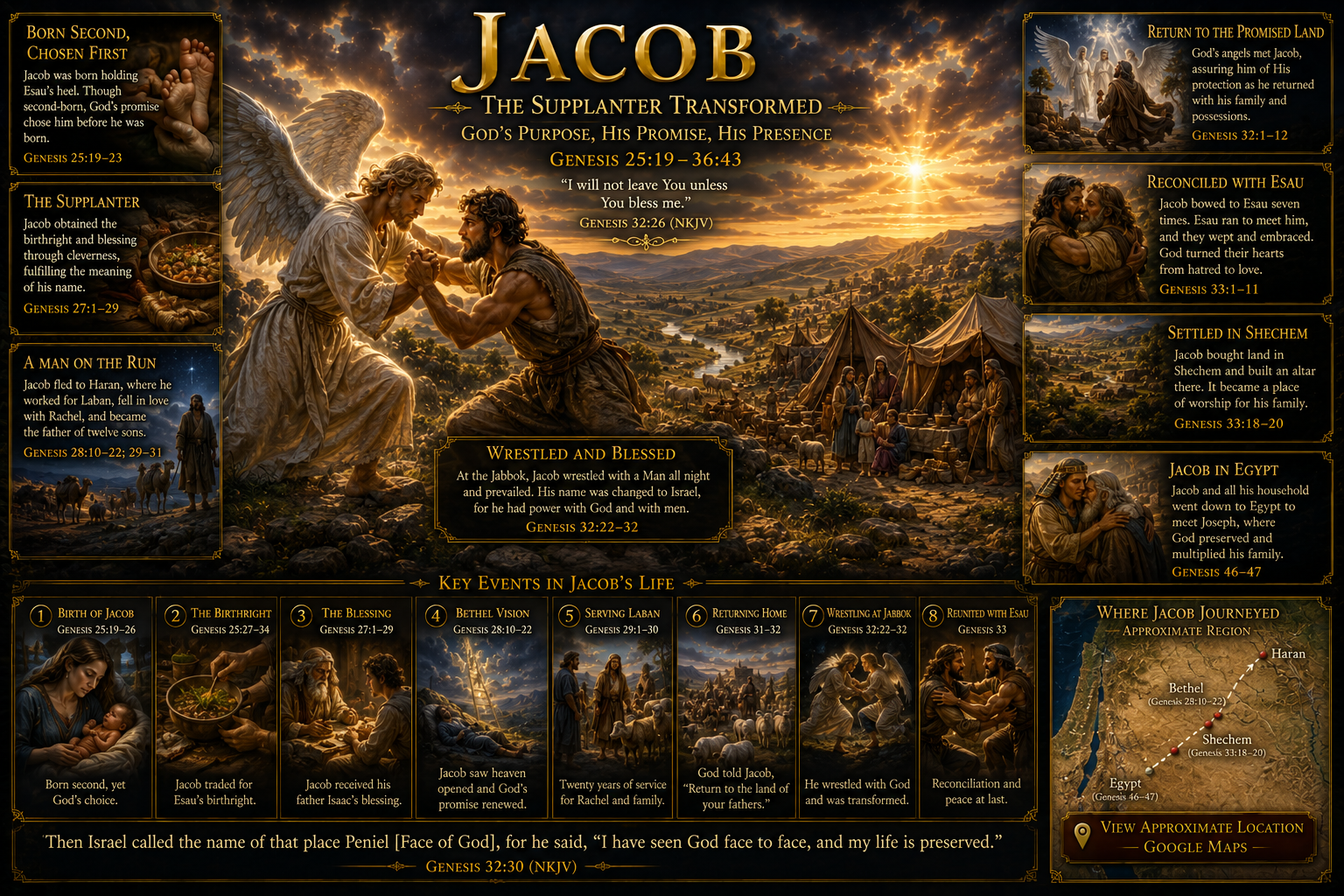
Jacob's story is filled with family conflict, divine encounters and transformation. Genesis does not hide his failures or the painful consequences within his family, yet God's covenant promise continues through him.
Rebekah gave birth to twins. Esau came out first, and afterward Jacob was born holding Esau's heel. Isaac was sixty years old when they were born. See Genesis 25:24–26.
When the children struggled within Rebekah, she inquired of the LORD. God told her that two nations were in her womb and that the older would serve the younger. See Genesis 25:22–23.
Esau returned from the field weary and asked Jacob for food. Jacob asked for Esau's birthright in exchange, and Esau sold it to him. See Genesis 25:29–34.
With Rebekah's help, Jacob presented himself to his aged father as Esau and received the blessing Isaac intended for his older son. Esau's anger forced Jacob to flee. See Genesis 27.
Jacob traveled toward Padan Aram to the household of Laban, Rebekah's brother. There he met Rachel at a well and eventually served Laban for many years. See Genesis 28–29.
Jacob served seven years for Rachel, but Laban gave Leah to him first. Jacob then agreed to serve another seven years for Rachel. See Genesis 29:15–30.
After years with Laban, the LORD told Jacob to return to the land of his fathers and to his family. Jacob departed with his household and possessions. See Genesis 31:1–18.
Jacob feared meeting Esau and prepared gifts ahead of him. When the brothers finally met, Esau ran to Jacob, embraced him, fell on his neck and kissed him, and they wept. See Genesis 32–33.
While fleeing from Esau, Jacob stopped for the night and used a stone for a pillow. He dreamed of a ladder reaching from earth to heaven with angels ascending and descending. Above it stood the LORD, who reaffirmed the promises of land, descendants and blessing that had been given to Abraham and Isaac. Jacob awoke in awe, set up the stone as a pillar and called the place Bethel.
Before meeting Esau, Jacob was left alone and wrestled with a Man until the breaking of day. Jacob refused to let go without a blessing. His name was changed from Jacob to Israel, and Jacob named the place Peniel because he said he had seen God face to face and his life had been preserved. The encounter left Jacob limping.
Jacob's twelve sons become foundational to the story of Israel. Genesis records them through Leah, Rachel, Bilhah and Zilpah. Joseph's story will dominate the closing chapters of Genesis.
Jacob's story connects Abraham and Isaac directly to the nation that would bear his new name. He begins as the younger twin caught in rivalry and family conflict, but his life repeatedly intersects with God's covenant faithfulness. At Bethel he receives the promise; at Peniel he receives a new name; and through his twelve sons the family story expands toward the tribes of Israel.
Continue the Genesis Collection
The Genesis collection now turns to Joseph: Jacob's beloved son who is betrayed by his brothers, sold into Egypt, falsely accused and imprisoned, yet ultimately raised by Pharaoh to a position through which many lives are preserved.